

 The L/D Ratio Explained: Balancing Pellet Quality with Low Energy Consumption
Introduction
In the feed pelleting industry, achieving the optimal balance between pellet quality and energy efficiency remains a constant challenge. Among the many technical parameters influencing this balance, the L/D ratio (Length-to-Diameter ratio) of ring dies plays a decisive role.
For feed mill operators and equipment buyers, understanding how the L/D ratio impacts pellet durability, throughput, and energy consumption is essential—not only for optimizing production but also for reducing operational costs and improving overall competitiveness.
This article breaks down the concept of L/D ratio through a practical and engineering-focused lens, following a structured approach: Problem → Principle → Solution → Conclusion.
1. The Problem: Why Pellet Quality and Energy Consumption Conflict
In feed production, two key performance indicators often work against each other:
- High pellet quality (durability, hardness, low fines)
- Low energy consumption (reduced kWh/ton)
The Trade-Off
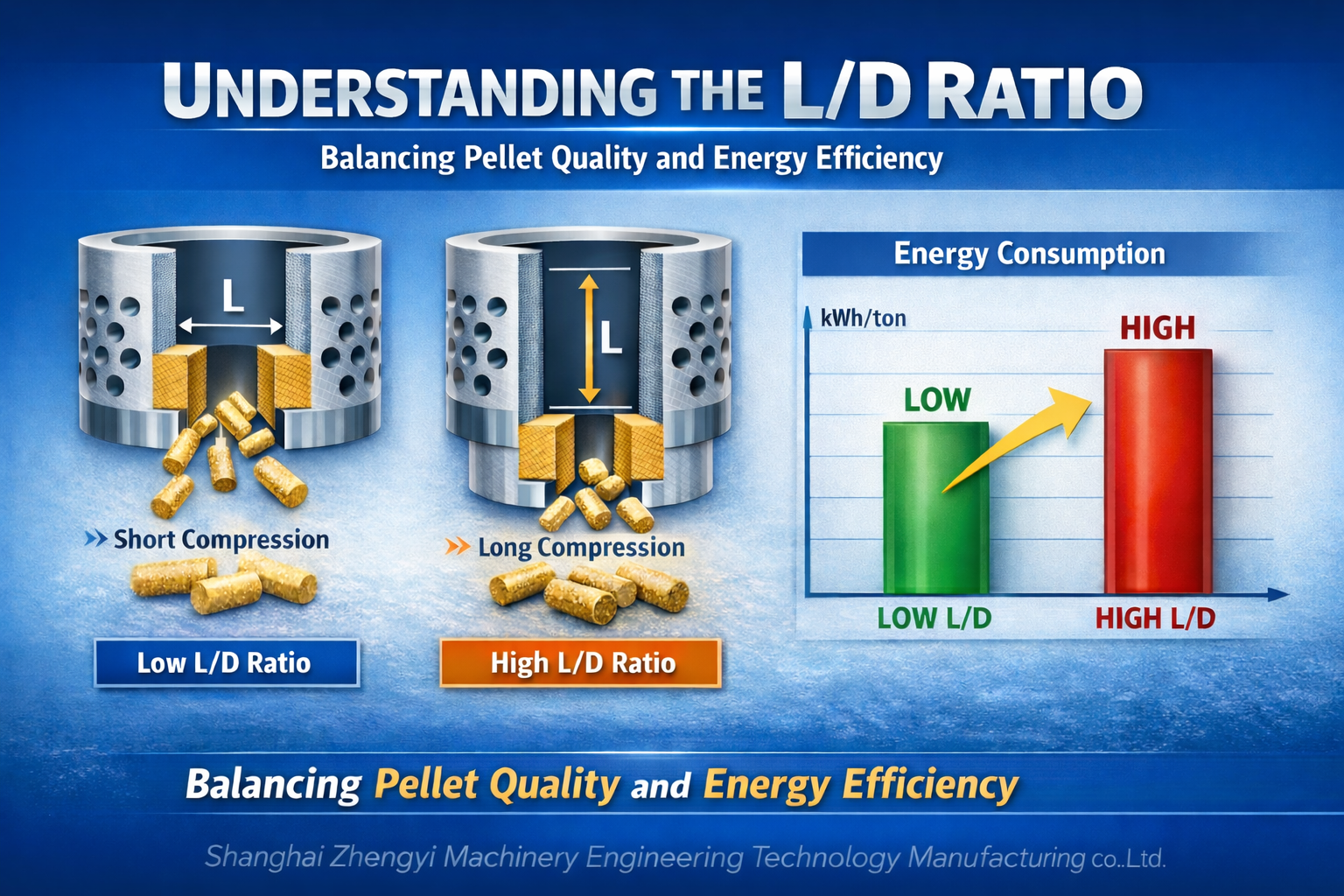
- Increasing compression improves pellet durability but raises energy consumption and reduces throughput.
- Reducing compression lowers energy use but may lead to poor pellet quality, higher fines, and customer complaints.
This trade-off is most directly influenced by the die configuration, especially the L/D ratio.
2. The Principle: What is the L/D Ratio?
The L/D ratio refers to:
The effective working length (L) of the die hole divided by its diameter (D)
Formula:
Physical Meaning
- L (Length): Determines how long material is compressed inside the die
- D (Diameter): Controls pellet thickness and flow resistance
Key Insight
The L/D ratio directly defines the compression intensity applied to feed material during pellet formation.
3. How L/D Ratio Affects Pelleting Performance
3.1 Pellet Quality (Durability & Hardness)
- Higher L/D ratio
- Stronger compression
- Better gelatinization of starch
- Higher pellet durability (PDI)
- Lower L/D ratio
- Insufficient compression
- Fragile pellets
- Increased fines during transport
3.2 Energy Consumption
- Higher L/D ratio
- Increased friction resistance
- Higher motor load
- Increased energy consumption (kWh/ton)
- Lower L/D ratio
- Easier material flow
- Lower energy usage
3.3 Production Capacity
- High L/D
- Reduced throughput due to resistance
- Low L/D
- Higher output, but potential quality loss
3.4 Die Lifetime
- High compression → more wear → shorter die life
- Balanced design → longer service life
4. Factors Influencing Optimal L/D Ratio
Selecting the correct L/D ratio is not a one-size-fits-all decision. It depends on multiple variables:
4.1 Feed Formulation
- High fiber (e.g., cattle feed)
→ Lower L/D required (material is harder to compress) - High starch (e.g., poultry feed)
→ Higher L/D suitable (better binding properties)
4.2 Raw Material Properties
- Moisture content
- Particle size distribution
- Fat content
4.3 Conditioning Quality
Better conditioning (steam, moisture, temperature) reduces the need for extreme L/D ratios.
4.4 Pellet Size
- Small diameter pellets → typically require higher L/D
- Large diameter pellets → lower L/D sufficient
5. Practical L/D Ratio Selection Guidelines
Below are general industry reference ranges:
|
Feed Type |
Typical L/D Ratio |
|
Poultry feed |
1:6 – 1:8 |
|
Livestock feed |
1:5 – 1:7 |
|
Aquafeed (sinking) |
1:8 – 1:12 |
|
Biomass pellets |
1:4 – 1:6 |
⚠️ Note: These values should always be adjusted based on real production data.
6. Engineering Solutions: How to Optimize L/D Ratio in Practice
6.1 Use Variable Compression Dies
Modern ring dies can incorporate:
- Relief holes
- Step compression designs
- Multi-stage compression zones
These innovations allow manufacturers to simulate different L/D effects without changing the entire die.
6.2 Match Die Design with Process Conditions
Instead of increasing L/D blindly, optimize:
- Conditioning temperature (80–90°C typical)
- Moisture addition
- Retention time
A well-conditioned mash reduces the need for excessive compression.
6.3 Monitor Key Performance Indicators (KPIs)
Track the following:
- Pellet Durability Index (PDI)
- Energy consumption (kWh/ton)
- Production rate (t/h)
- Die wear rate
Use these KPIs to continuously refine L/D selection.
6.4 Customize for Export Markets
For international feed producers, requirements differ:
- Southeast Asia → focus on durability (high humidity transport)
- Middle East → focus on energy efficiency (high electricity costs)
- Europe → strict sustainability standards
Custom L/D design improves competitiveness in global markets.
7. Common Mistakes to Avoid
❌ Overestimating L/D Ratio
Leads to:
- High power consumption
- Die choking
- Reduced output
❌ Ignoring Raw Material Variability
Different batches require different compression behavior.
❌ One-Die-Fits-All Approach
Each formulation should ideally have a tailored die design.
8. Industry Trend: Toward Energy-Efficient Pelleting
With rising global energy costs and sustainability pressures, the industry is shifting toward:
- Lower energy consumption per ton
- Smart die design
- Digital monitoring systems
Optimizing the L/D ratio is one of the most cost-effective ways to achieve these goals without major equipment upgrades.
Conclusion
The L/D ratio is far more than a simple geometric parameter—it is a core engineering lever that directly impacts pellet quality, energy efficiency, and production profitability.
Key Takeaways:
- A higher L/D ratio improves pellet quality but increases energy consumption
- A lower L/D ratio saves energy but risks poor pellet durability
- The optimal balance depends on feed type, raw materials, and process conditions
- Advanced die design and process optimization can achieve both quality and efficiency
About Us
Shanghai Zhengyi Machinery Engineering Technology Manufacturing Co., Ltd. specializes in high-performance ring dies, pellet mill components, and turnkey solutions for the global feed and biomass industries. With a strong focus on precision manufacturing and application-driven engineering, we help customers optimize die configurations—such as L/D ratio—for maximum productivity and cost efficiency.
For more details and knowledge about ring die, please visit www.cpshzy.com