

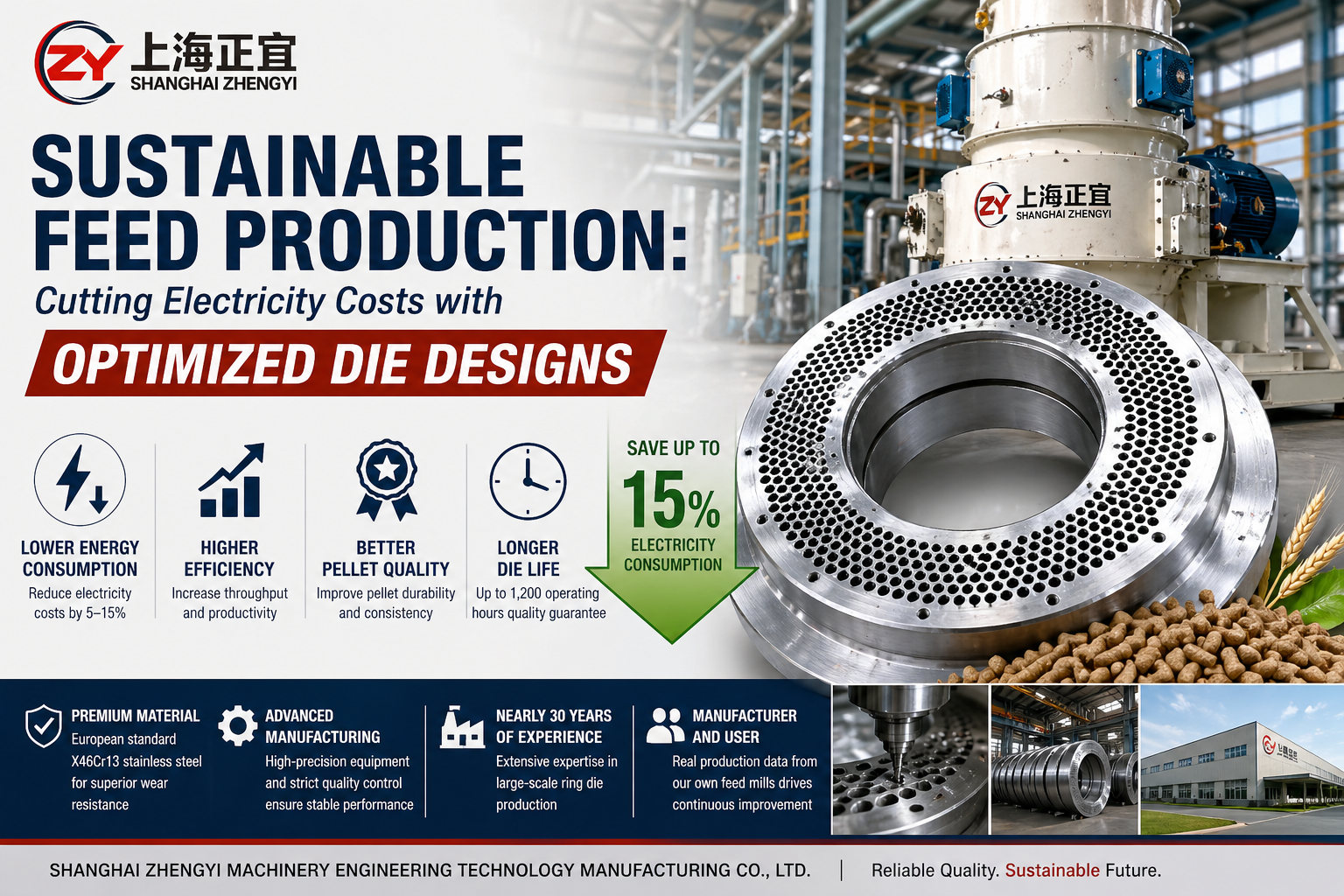
Sustainable Feed Production: Cutting Electricity Costs with Optimized Die Designs
Introduction: The Hidden Cost in Feed Production
In modern feed manufacturing, energy consumption has become one of the most critical cost drivers. Among all processes, pelleting often accounts for more than 30% of total electricity usage. While many producers focus on upgrading machinery, one key factor is frequently overlooked: ring die design.
At Shanghai Zhengyi Machinery Engineering Technology Manufacturing Co., Ltd., we have seen how optimized die design can significantly reduce energy consumption while improving production efficiency and pellet quality.
The Problem: Rising Energy Costs in Pelleting
Feed mills today face increasing challenges:
- Escalating electricity prices
- Pressure to reduce carbon emissions
- Demand for higher production efficiency
- Variability in raw materials
An improperly designed ring die can lead to:
- Higher motor load
- Reduced throughput
- Increased wear and maintenance
- Inconsistent pellet quality
In many cases, excessive power consumption is not due to the pellet mill itself, but rather an inefficient die configuration.
The Principle: Why Die Design Matters
The ring die is the core component of the pelleting process. Its design directly affects material flow, compression, and pellet formation.
Key Factors Influencing Energy Consumption
1. Compression Ratio (L/D Ratio)
A higher compression ratio increases resistance and energy consumption, while a lower ratio may compromise pellet quality. The optimal balance depends on feed formulation and process conditions.
2. Hole Structure Design
Advanced hole geometries (such as stepped or relief designs) can reduce internal resistance and improve extrusion efficiency, lowering energy demand.
3. Surface Finish
Smooth internal hole surfaces minimize friction, enabling easier material flow and reducing motor load.
4. Material Selection
Using high-quality materials such as X46Cr13 stainless steel ensures:
- Higher wear resistance
- Stable performance
- Long-term energy efficiency
The Solution: Optimized Ring Die Design
To achieve sustainable feed production, a systematic optimization approach is essential.
Customized Design for Different Feed Types
Different feed formulations require tailored die specifications to ensure optimal performance and efficiency.
High-Quality Raw Materials
At Shanghai Zhengyi Machinery Engineering Technology Manufacturing Co., Ltd., we use European standard X46Cr13 and source forged blanks from top-tier suppliers, ensuring consistent material performance.
Advanced Manufacturing Processes
Our production is supported by:
- High-precision drilling technology
- Strict quality control systems
- Advanced processing equipment
These ensure consistent hole accuracy and reduced friction.
Data-Driven Optimization
As both a manufacturer and user of ring dies, our products are extensively applied in our own feed mills. This provides valuable real-world data, allowing continuous improvement in design and performance.
Results: Measurable Benefits
By optimizing ring die design, feed mills can achieve:
Lower Energy Consumption
- Reduce electricity usage by 5–15%
- Lower production costs
Higher Productivity
- Increased throughput
- Reduced downtime
Better Pellet Quality
- Improved durability (PDI)
- Consistent output
Extended Service Life
- Up to 1,200 operating hours quality guarantee
- Reduced replacement frequency
Sustainability Impact
Optimized die design supports sustainability by:
- Reducing energy consumption
- Lowering carbon emissions
- Improving resource efficiency
This makes it a practical solution for feed producers aiming for greener operations.
Conclusion: A Strategic Upgrade for Feed Mills
Ring dies may seem like a small component, but their impact on energy efficiency is significant.
With nearly 30 years of manufacturing experience, Shanghai Zhengyi Machinery Engineering Technology Manufacturing Co., Ltd. delivers high-performance ring dies designed for efficiency, durability, and sustainability.
Optimizing die design is not just a technical improvement, it is a strategic step toward cost reduction and sustainable feed production.