

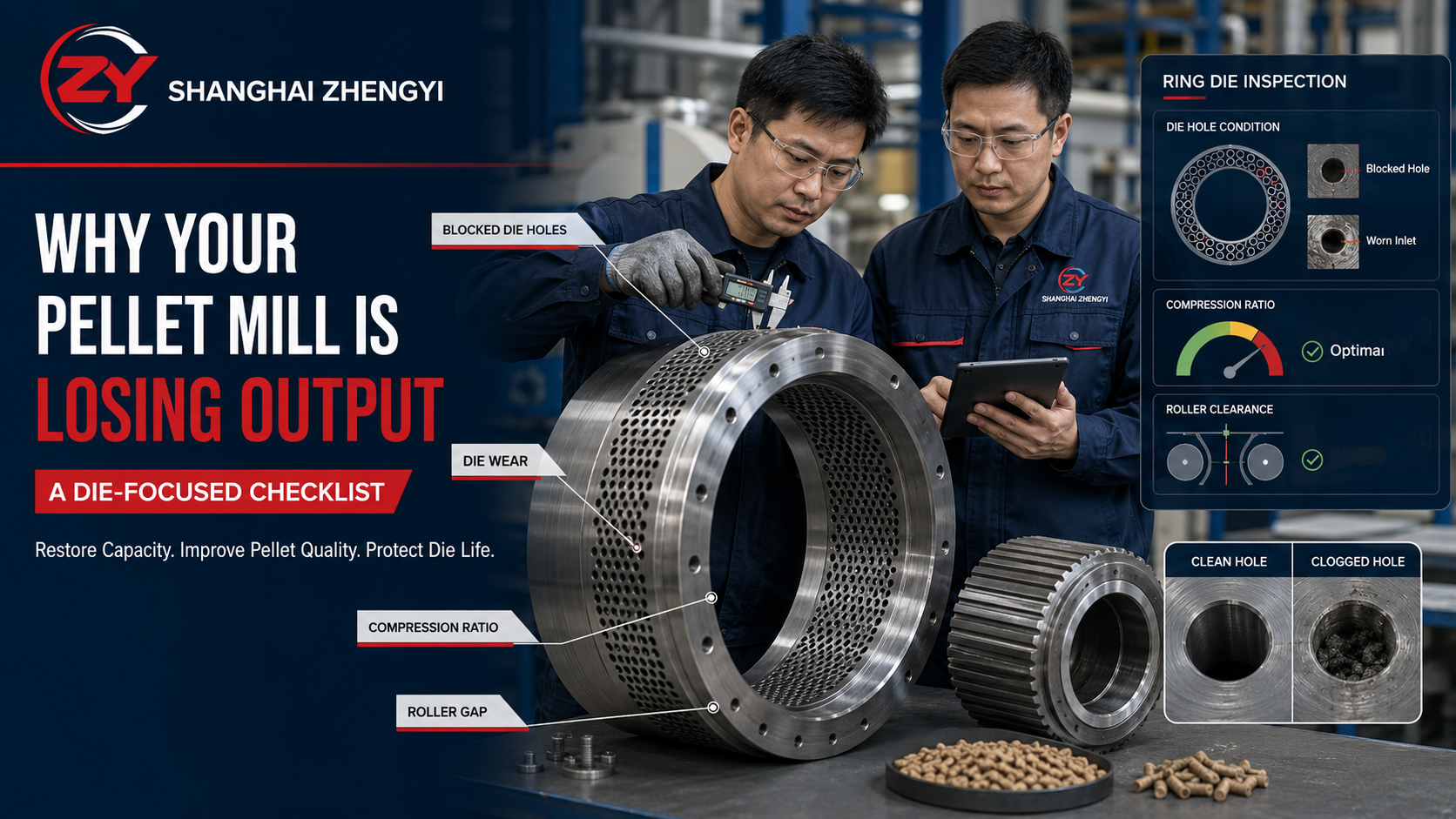
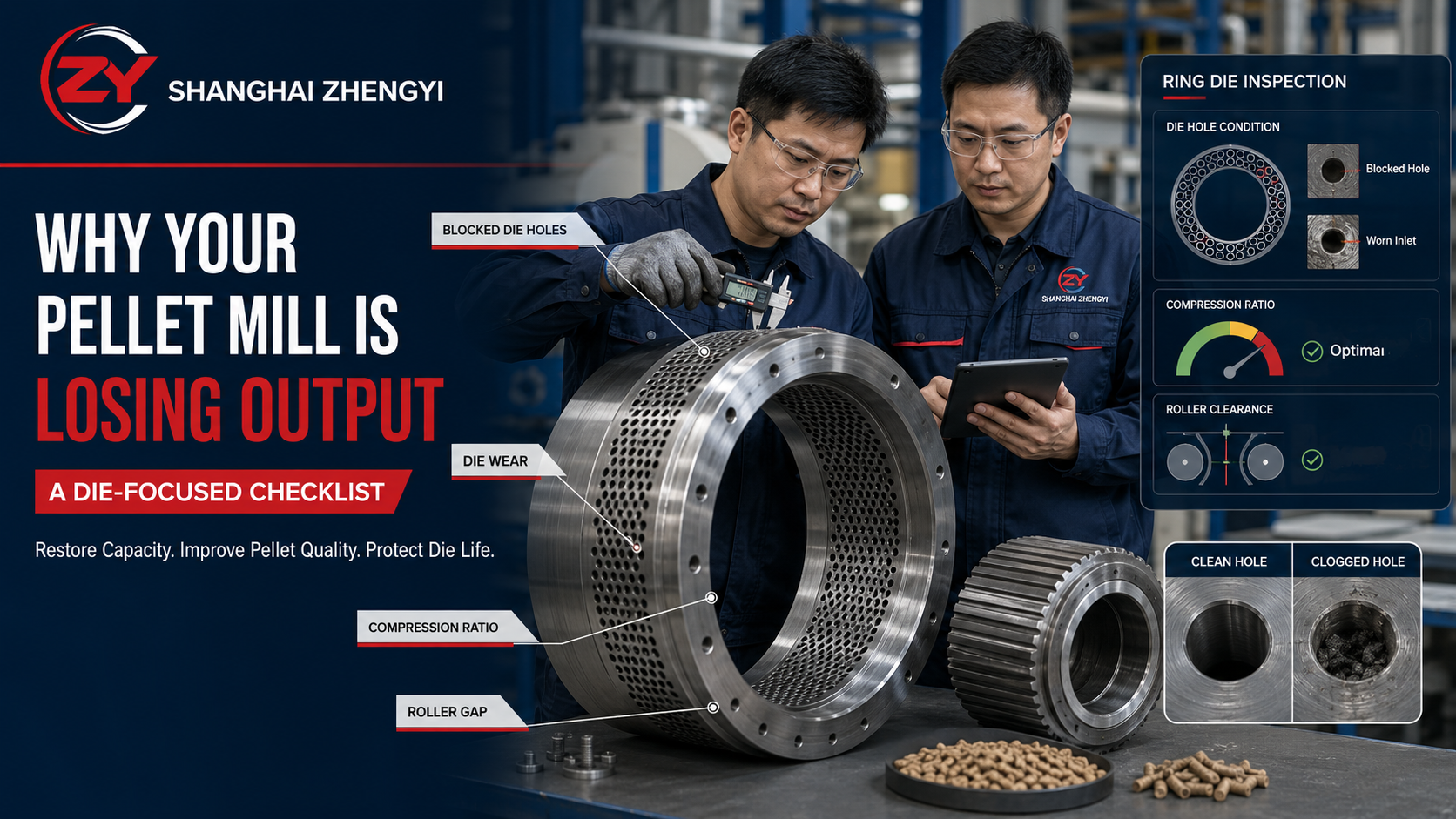
 SEO Title: Why Your Pellet Mill Is Losing Output Rate: A Die-Focused Troubleshooting Checklist
A pellet mill rarely loses output without warning. Capacity may decline gradually over several weeks, or it may drop suddenly after a die change, formula adjustment, maintenance shutdown, or raw-material change.
When this happens, the ring die is often blamed first—and sometimes correctly. Die wear, blocked holes, an unsuitable compression ratio, or poor die manufacturing can significantly restrict material flow. However, the die does not work alone. Feed formulation, conditioning, roller adjustment, particle size, motor load, and mechanical condition all interact with the die.
Replacing the die before identifying the real cause can therefore be expensive and ineffective.
This checklist provides a practical, die-focused method for diagnosing pellet mill capacity loss. It is intended for feed mills, biomass pellet plants, maintenance teams, production managers, and purchasing professionals who need to determine whether the problem comes from the ring die, the operating conditions, or both.
1 Confirm That the Capacity Loss Is Real
Before dismantling the pellet mill, confirm that the output decline is based on comparable operating data.
Compare the current production run with a previous stable run using:
- The same or a similar formulation
- The same pellet diameter
- A comparable raw-material moisture level
- Similar conditioning temperature and steam pressure
- The same die specification
- Similar motor load
- The same production time and weighing method
A lower hourly output does not automatically indicate a defective die. For example, a new formula containing more fiber, minerals, fat, or heat-sensitive ingredients may behave differently from the previous product.
Record at least the following information:
- Actual output in tonnes per hour
- Main motor current or power consumption
- Die operating hours
- Pellet diameter
- Effective hole length
- Conditioning temperature and moisture
- Percentage of blocked die holes
- Roller shell condition
- Pellet durability and fines level
This baseline helps separate a real equipment problem from a normal change caused by the product or process.
2 Check for Blocked or Partially Blocked Die Holes
Blocked die holes are one of the most direct causes of pellet mill capacity loss. When fewer holes are available, the effective open area of the die decreases. The remaining holes must process more material, increasing resistance and reducing throughput.
A die may appear clean from the surface while still containing restrictions deeper inside the holes.
Common causes of blockage include:
- Material left inside the die after an improper shutdown
- Insufficiently conditioned feed
- Excessively dry or fibrous material
- Foreign particles or metal contamination
- Corrosion during storage
- Burnt or hardened material inside the holes
- Incorrect start-up or shutdown procedures
- Poor initial die-hole finishing
Inspect both the inner and outer surfaces of the ring die. Look for areas where pellets are not being discharged evenly. Dark sections, irregular pellet flow, or local temperature differences may indicate blocked-hole zones.
If blockage is limited, the die may be cleaned or professionally refurbished. Severe blockage, cracking, excessive wear, or structural damage may make replacement the safer option.
Never use uncontrolled drilling to open blocked holes. Incorrect drilling can enlarge the holes, damage the internal finish, change pellet dimensions, and weaken the die.
3 Verify the Die Compression Ratio
The die compression ratio—often expressed as the relationship between effective hole length and hole diameter—is one of the most important factors affecting capacity, pellet quality, power consumption, and die life.
A longer effective hole length creates more resistance as material passes through the die. This may improve pellet density and durability, but excessive resistance can reduce output, increase motor load, generate more heat, and cause blockage.
A shorter effective length normally allows material to pass more easily. However, if the resistance is too low, pellets may become soft, fines may increase, and the required pellet quality may not be achieved.
The correct compression ratio depends on more than pellet diameter. It must also match:
- Feed formulation
- Raw-material characteristics
- Fiber and fat content
- Particle size
- Conditioning performance
- Required pellet durability
- Pellet mill model and available motor power
- Animal species or biomass application
If capacity dropped immediately after installing a new die, compare its complete specification with the previous successful die. Do not check only the outside dimensions and hole diameter. Confirm the effective hole length, relief depth, inlet geometry, hole pattern, open area, material, hardness, and surface finish.
A die can fit the pellet mill mechanically and still be unsuitable for the actual product.
4 Inspect Die-Hole Wear
Ring die holes do not wear uniformly. The inlet section, working channel, and outlet area may develop different wear patterns depending on the material, operating conditions, and roller setting.
Typical signs include:
- Enlarged or oval holes
- Bell-mouthed hole entrances
- Uneven wear across the working track
- Damaged countersinks
- Rough internal hole surfaces
- Reduced effective compression
- Cracks around the hole area
- Uneven pellet length or diameter
Wear can affect output in different ways. In some cases, worn holes reduce resistance and temporarily increase flow, but pellet quality deteriorates. In other cases, uneven wear disturbs material distribution, causes roller slippage, and lowers overall capacity.
Do not judge a die only by its total operating hours. Abrasive mineral content, sand contamination, formulation, die material, hardness, roller pressure, and production practices can cause major differences in service life.
A proper inspection should evaluate both dimensional wear and structural condition.
5 Check the Die Open Area and Hole Pattern
The number and arrangement of die holes determine how much effective discharge area is available. For the same die size, a poorly optimized hole pattern may provide less open area and lower potential throughput.
Important factors include:
- Hole diameter
- Number of holes
- Distance between holes
- Working-track width
- Unperforated areas
- Hole distribution
- Structural strength requirements
Increasing the number of holes is not always the correct solution. If holes are positioned too closely, the die may lose mechanical strength and become more vulnerable to cracking.
A professional die design must balance capacity, structural integrity, service life, and pellet quality. This is why copying only the basic dimensions of an existing ring die may not reproduce its actual performance.
For replacement-die evaluation, request a complete technical drawing rather than relying only on the pellet mill model.
6 Examine Die-Hole Finish and Manufacturing Accuracy
Internal hole quality directly affects how smoothly material travels through the die.
Rough holes, machining marks, burrs, inconsistent diameters, misaligned drilling, or poorly finished inlets create unnecessary friction. The result may be:
- Difficult die start-up
- Reduced production capacity
- Higher power consumption
- Uneven pellet discharge
- Repeated blockage
- Excessive heat
- Shorter die life
A new die normally requires an appropriate running-in procedure, but it should not remain difficult to operate for an extended period. If a new die cannot approach normal capacity despite correct conditioning and adjustment, its hole finish and specification should be examined.
Precision drilling, controlled heat treatment, stable hardness, and proper finishing are therefore not merely manufacturing details. They directly influence operating performance.
7 Inspect the Roller Shells and Die–Roller Gap
The ring die cannot perform efficiently if the roller shells are worn, slipping, incorrectly installed, or unevenly adjusted.
If the gap is too large, the rollers may fail to grip and compress the material effectively. Symptoms can include:
- Low output
- Unstable feeding
- Roller slippage
- Uneven die-track loading
- Excessive material accumulation inside the pelleting chamber
If the gap is too small, metal-to-metal contact may occur. This accelerates wear, increases heat and vibration, wastes energy, and can damage both the ring die and roller shells.
Check for:
- Uneven roller-shell wear
- Worn corrugations
- Damaged bearings
- Restricted roller rotation
- Material build-up
- Incorrect roller adjustment
- Misalignment between the rollers and die track
Always follow the pellet mill manufacturer’s adjustment procedure. A setting that worked with a worn die may not be correct after a new die is installed.
8 Review Feed Distribution Across the Die
Uneven feed distribution means that only part of the die is doing most of the work. One section may become overloaded while another remains underused.
This can lead to:
- Localized die wear
- Uneven roller-shell wear
- Lower effective capacity
- Increased vibration
- Unstable motor load
- Irregular pellet quality
Inspect the feeder, deflectors, scrapers, knives, and distribution components inside the pelleting chamber. Material should reach the working track consistently rather than accumulating in one area.
If the wear pattern is concentrated on one side of the die, the problem may be feed distribution or mechanical alignment—not the die material itself.
9 Confirm Raw-Material Particle Size
Particle size strongly influences how material enters and moves through the die holes.
Oversized particles can create bridging, poor compaction, unstable pellet formation, and blockage. Extremely fine grinding may also create problems, including higher energy consumption during grinding, changes in moisture absorption, or excessive friction during pelleting.
Check:
- Hammer-mill screen condition
- Screen-hole size
- Hammer wear
- Grinder capacity
- Particle-size distribution
- Presence of unground ingredients
- Formula-specific grinding requirements
Do not rely only on visual inspection. A sieve analysis provides much more reliable evidence.
If capacity changes after replacing a grinder screen or adjusting the grinding system, investigate particle size before concluding that the ring die is defective.
10 Evaluate Conditioning Quality
Proper conditioning helps soften the feed, distribute moisture, activate natural binders, and improve material flow through the die.
Poor conditioning can create high die resistance even when the ring die is correctly designed.
Review:
- Steam quality
- Steam pressure and stability
- Conditioning temperature
- Moisture addition
- Retention time
- Paddle condition and angle
- Conditioner fill level
- Condensate removal
- Feed-rate consistency
Dry feed generally creates greater friction, while excessive moisture can cause slipping, choking, poor pellet formation, or downstream drying and cooling problems.
Do not treat temperature as the only conditioning indicator. Two production runs at the same temperature may have different moisture content, retention time, and steam quality.
11 Check Formula Changes and Lubrication Effects
Even a small formulation change can alter die resistance.
Ingredients that may affect pellet mill performance include:
- Fiber-rich materials
- Minerals
- High-protein ingredients
- Starch sources
- Molasses
- Added oils or fats
- Alternative raw materials
- Recycled fines
Added fat can improve lubrication and increase flow up to a point, but excessive fat may reduce pellet durability. Fibrous materials may require a different die design from conventional poultry or pig feed. Mineral-rich formulas can increase abrasive wear.
When investigating low output, ask a simple but critical question: What changed before the capacity dropped?
The answer may be a new supplier, seasonal raw-material variation, revised formula, different moisture level, or increased liquid addition—not a sudden failure of the pellet mill.
12 Compare Motor Load with Output
Motor load provides valuable diagnostic information.
Low output with high motor load usually suggests excessive resistance. Possible causes include:
- Compression ratio too high
- Blocked die holes
- Poor conditioning
- Dry material
- Excessive roller pressure
- Mechanical friction
Low output with unusually low motor load may suggest:
- Insufficient feed supply
- Feeder limitation
- Roller slippage
- Poor material distribution
- Low die resistance
- Drive-system problems
The objective is not simply to maximize motor load. Stable operation within the equipment manufacturer’s recommended range is more important than forcing material through the die.
Record motor current together with output, formulation, die hours, and conditioning data. A trend is much more useful than a single reading.
13 Decide Whether to Clean, Refurbish, Redesign, or Replace the Die
Once the inspection is complete, choose the corrective action according to the actual condition.
Cleaning may be appropriate when the die is structurally sound but has blocked holes or storage contamination.
Refurbishment may be considered when wear or partial blockage can be corrected without compromising die strength or pellet dimensions.
Redesign may be necessary when the die repeatedly produces low capacity despite being in good physical condition. In this case, the hole pattern, effective length, relief, inlet design, or material application may be unsuitable.
Replacement is normally the best option when the die has cracks, severe wear, dimensional instability, extensive damage, or insufficient remaining structural strength.
The lowest purchase price is not always the lowest operating cost. A correctly specified die can help reduce downtime, stabilize production, control energy consumption, and improve pellet consistency.
Information to Send Your Ring Die Supplier
Accurate troubleshooting requires accurate data. When requesting technical support or a replacement die, provide:
- Pellet mill brand and model
- Ring die inner diameter, outer diameter, total width, and working width
- Hole diameter
- Effective hole length
- Total die thickness and relief details
- Raw-material type or feed formula category
- Required output
- Current actual output
- Main motor power and operating current
- Conditioning temperature and moisture
- Die operating hours
- Pellet quality requirements
- Photos of the inner surface, outer surface, and working track
- Existing die drawing or identification number
- Description of when the problem began
Whenever possible, send a used die sample or arrange professional dimensional measurement. Machine model alone is not always sufficient because dies for the same pellet mill can have different hole specifications and applications.
Final Takeaway
A ring die is a critical part of pellet production, but it should never be evaluated in isolation.
The most reliable troubleshooting process follows the material from the feeder and conditioner to the rollers, die holes, pellet chamber, and final discharge. It compares measurable operating data instead of replacing parts based on assumptions.
If your pellet mill is losing output, begin with three questions:
- 1 Has the raw material or formula changed?
- 2 Is the die providing the correct open area and resistance?
- 3 Are conditioning, roller adjustment, and feed distribution allowing the die to work properly?
The answers will help determine whether you need an operating adjustment, die cleaning, refurbishment, or a newly engineered ring die.
Need Help Diagnosing Pellet Mill Capacity Loss?
CPSHZY supplies ring dies, roller shells, roller assemblies, and related pellet mill wear parts for a wide range of feed and biomass applications.
Our technical team can evaluate your existing die specification, operating conditions, raw material, required pellet quality, and production target before recommending a solution. The objective is not simply to supply a die that fits the machine, but to help select a die configuration suited to the actual application.
Send us your pellet mill model, die drawing, product information, current output, target capacity, motor load, and clear photos of the used die. We will review the available information and assist with specification verification and technical evaluation.
Contact CPSHZY for a ring die quotation or pellet mill troubleshooting support.
Frequently Asked Questions
Why is my pellet mill producing fewer tonnes per hour?
Common causes include blocked or worn die holes, an unsuitable compression ratio, poor conditioning, incorrect roller adjustment, inconsistent feeding, unsuitable particle size, formula changes, or mechanical problems. Compare operating data before replacing the die.
Can a new ring die cause lower output?
Yes. A new die may temporarily require proper running-in, but persistent low output can indicate excessive compression, insufficient open area, rough hole finishing, an incorrect hole pattern, or a specification that does not match the raw material.
Does a higher die compression ratio produce better pellets?
Not automatically. Higher resistance may improve density and durability for some products, but excessive compression can reduce capacity, increase power consumption, and cause blockage. The ratio must match the formulation, pellet diameter, machine power, and quality target.
When should a pellet mill die be replaced?
Replacement should be considered when the die is cracked, severely worn, dimensionally unstable, extensively damaged, or no longer capable of meeting production and pellet-quality requirements safely. A blocked but structurally sound die may be suitable for professional cleaning or refurbishment.
What information is needed to quote a replacement ring die?
Provide the pellet mill brand and model, die dimensions, hole diameter, effective hole length, working width, relief details, raw-material type, required capacity, motor power, and preferably the existing die drawing or a sample for measurement.