A Technical Guide to Selecting the Correct L/D Ratio in Pellet Mill Ring Dies
Executive Summary (for Google Discover & AI Overview)
Ring die compression ratio—commonly defined as the L/D ratio (effective hole length divided by hole diameter)—is a critical engineering parameter that directly determines pellet durability, energy consumption, die life, and overall production stability in feed pellet manufacturing.
Contrary to common assumptions, pellet quality issues are more frequently caused by mismatched die compression design than by formulation errors alone.
Based on long-term field experience and engineering practice, Shanghai Zhengyi Machinery Engineering Technology Manufacturing Co., Ltd. emphasizes that different animal feeds require fundamentally different compression ratios. There is no universal L/D value suitable for all feed types.
This article provides a practical, feed-specific selection logic for poultry, ruminant, aquafeed, and specialty formulations—helping feed producers optimize pellet quality while minimizing operational risk.
Core Objective
The objective of this technical guide is to:
- Clearly define the engineering meaning of ring die compression ratio
- Explain why different feed types require different L/D ratios
- Provide practical reference ranges based on animal nutrition and mechanical behavior
- Help feed producers improve:
- Pellet durability and consistency
- Die service life
- Energy efficiency
- Long-term operational stability
1. What Is Ring Die Compression Ratio (L/D Ratio)?
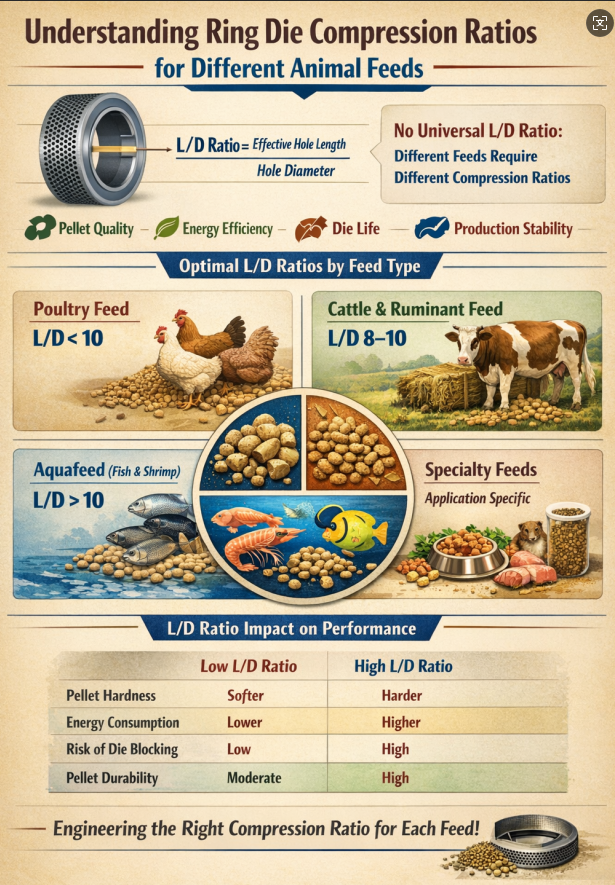
The ring die compression ratio is defined as:
Compression Ratio (L/D) = Effective Hole Length (L) ÷ Hole Diameter (D)
From an engineering standpoint, this ratio directly influences:
- Material residence time inside the die hole
- Degree of compaction and internal friction
- Friction-generated heat and starch gelatinization
- Pellet density, hardness, and surface integrity
- Main motor load, energy consumption, and die wear rate
In modern pellet mills, the ring die does not function merely as a shaping component.
It operates as a controlled compression reactor, where pressure, shear force, and thermal energy interact to determine final pellet properties.
2. Why Compression Ratio Must Match Feed Type
Different animal feeds exhibit significant variation in physical and nutritional characteristics, including:
- Fiber content
- Starch structure and gelatinization demand
- Fat and oil inclusion level
- Moisture sensitivity
- Required pellet density and durability
As a result, a single compression ratio cannot satisfy all feed applications.
According to Shanghai Zhengyi’s long-term operational data, improper L/D selection is one of the primary causes of:
- Die choking and unstable production
- Fragile pellets with excessive fines
- Abnormal roller slip and uneven wear
- Excessive power consumption
Correct compression ratio selection is therefore a system-level engineering decision, not a simple dimensional choice.
3. Typical L/D Ratio Ranges by Feed Type
(1) Poultry Feed (Broiler, Layer, Breeder)
Recommended L/D Ratio: < 10
Engineering rationale:
- Poultry feeds typically contain higher starch levels and moderate fat content
- Excessive compression can lead to:
- Overheating
- Nutrient degradation
- Surface cracking and poor pellet appearance
- Poultry do not require extremely hard pellets
Design focus:
- Shorter effective hole length
- Smooth pellet discharge
- Stable throughput with lower specific energy consumption
A lower compression ratio provides sufficient pellet integrity without unnecessary mechanical stress.
(2) Cattle and Ruminant Feed
Recommended L/D Ratio: 8–10 (occasionally slightly higher)
Engineering rationale:
- High fiber content increases extrusion resistance
- Ruminants tolerate coarser and denser pellets
- Moderate compression improves cohesion while avoiding die blockage
Design focus:
- Balanced pressure distribution
- Controlled friction levels
- Acceptable die life under abrasive, fibrous conditions
(3) Aquafeed (Fish and Shrimp Feed)
Recommended L/D Ratio: > 10
Engineering rationale:
Aquafeed production places exceptional demands on pellet structure, including:
High water stability
- Controlled pellet density (sinking feed)
- Expansion control (floating feed)
Higher compression ratios contribute to:
- Improved pellet integrity
- Reduced water disintegration
More predictable buoyancy behavior
Design focus:
- Longer effective hole length
- Controlled pressure release
- Compatibility with advanced conditioning or extrusion processes
In aquafeed, compression ratio directly influences buoyancy and water stability, making precise die design essential.
(4) Special Feeds (Pet Food, High-Fat, Functional Feeds)
Recommended L/D Ratio: Application-specific
Key considerations:
- High-fat formulations require lower compression to prevent slippage
- Functional or specialty feeds may need:
- Multi-stage compression
- Customized taper or relief profiles
- Standard dies often fail to meet these requirements
For such applications, Shanghai Zhengyi typically recommends fully customized ring die designs rather than generic configurations.
4. Relationship Between L/D Ratio and Pellet Mill Performance
|
Parameter |
Low L/D Ratio |
High L/D Ratio |
|
Pellet hardness |
Lower |
Higher |
|
Energy consumption |
Lower |
Higher |
|
Risk of die blocking |
Low |
Higher |
|
Pellet durability |
Moderate |
High |
|
Die wear rate |
Lower |
Higher |
This comparison illustrates that compression ratio selection is a trade-off optimization problem, not a pursuit of maximum compression.
Conclusion
Ring die compression ratio is not a minor adjustment—it is a core engineering parameter that defines pellet quality, production stability, and long-term operating efficiency.
Shanghai Zhengyi Machinery Engineering Technology Manufacturing Co., Ltd. emphasizes that successful pellet production is achieved not by maximizing compression, but by engineering the correct level of compression for each specific feed application.
As feed producers face increasing pressure from energy costs, quality consistency, and operational efficiency, mastery of L/D ratio selection has become a decisive competitive advantage in modern feed manufacturing.