

How Smart Feed Mills Use IoT Sensors to Prevent Equipment Failure
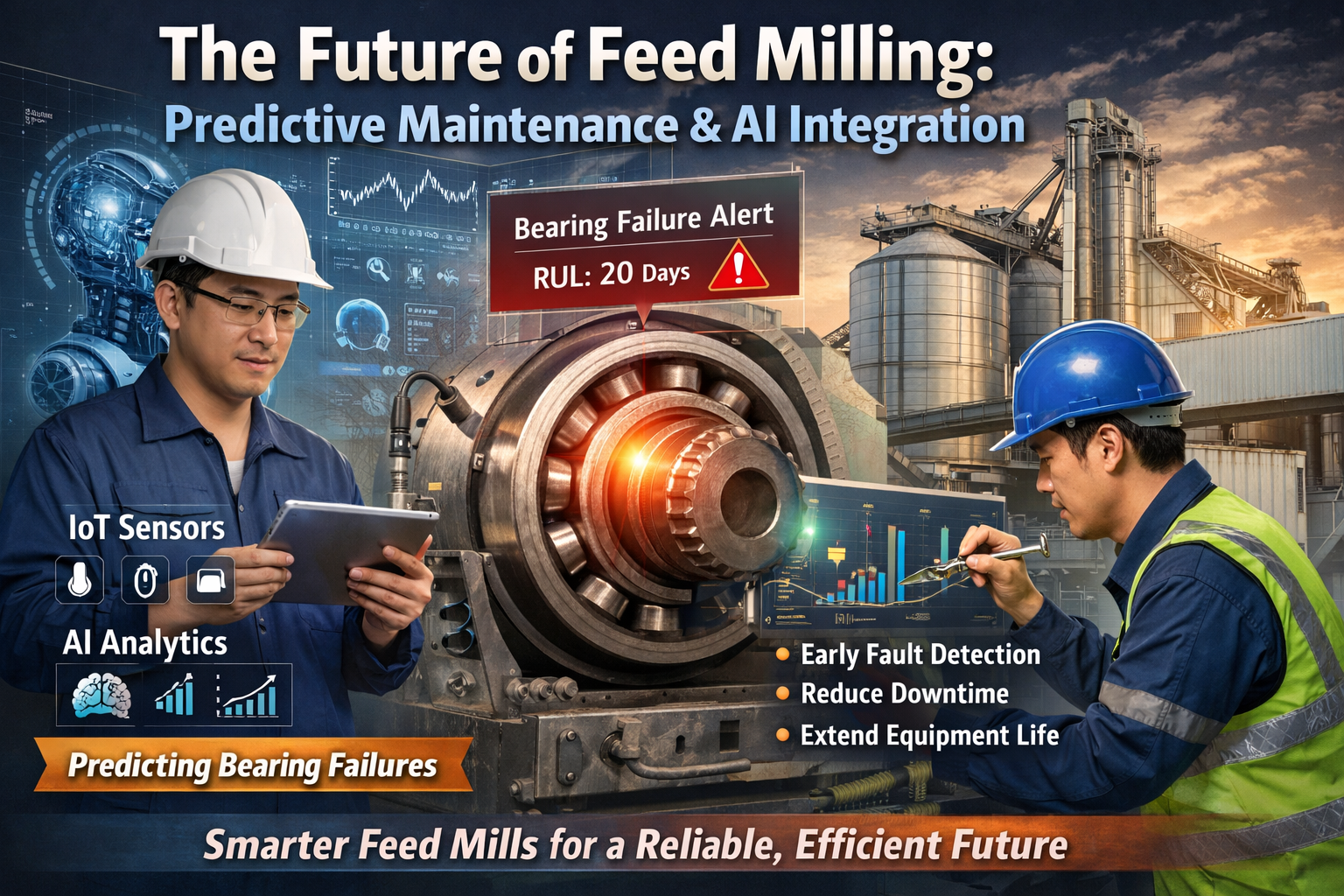
Introduction: The Next Evolution of the Smart Feed Mill
The global feed industry is entering a new technological phase. As feed mills scale production and pursue higher efficiency, traditional maintenance approaches—such as scheduled servicing or reactive repairs—are no longer sufficient.
Unexpected downtime in critical equipment such as pellet mills, hammer mills, conveyors, or mixers can halt entire production lines, resulting in significant financial loss.
This is why predictive maintenance powered by AI and IoT sensors is rapidly becoming a core component of the smart feed mill.
By continuously monitoring machine conditions—such as vibration, temperature, and acoustic signals—modern feed mills can detect early signs of equipment wear. In particular, bearing failures, one of the most common causes of pellet mill downtime, can now be predicted weeks before catastrophic failure occurs.
This article explores how AI in agriculture equipment and predictive maintenance technologies are transforming feed mill operations and how feed producers can implement these solutions to improve reliability, efficiency, and profitability.
The Problem: Unexpected Equipment Failures in Feed Mills
In most feed mills, maintenance still follows two conventional strategies:
1. Reactive Maintenance (Run-to-Failure)
Equipment is repaired only after it fails.
Risks include:
l Sudden production stoppages
l Expensive emergency repairs
l Damage to surrounding components
l Lost production capacity
l Delayed feed deliveries to customers
2. Preventive Maintenance (Time-Based)
Equipment components are replaced at fixed intervals regardless of actual condition.
Limitations include:
l Unnecessary part replacement
l Increased maintenance costs
l Failure still possible between intervals
For pellet mills, one of the most critical risks involves bearing failure in the main shaft or roller assembly.
A bearing failure can cause:
l Roller seizure
l Die damage
l Shaft misalignment
l Gearbox stress
In severe cases, the pellet mill may be forced offline for several days, resulting in substantial production losses.
The feed industry therefore requires a more intelligent maintenance approach.
The Principle: How Predictive Maintenance Works
Predictive maintenance is built on continuous condition monitoring using IoT sensors and AI analytics.
Instead of relying on scheduled inspections, the system constantly collects operational data from equipment and analyzes it to detect early failure patterns.
Key Technologies Used
1. IoT Sensors
Smart sensors are installed on critical components such as:
l Pellet mill bearings
l Main motor housing
l Gearbox casing
l Roller assemblies
l Conveyors and elevators
These sensors monitor:
l Vibration frequency
l Temperature changes
l Rotational speed
l Acoustic emissions
Even small deviations from normal operating patterns can indicate the early stages of mechanical wear.
2. AI Data Analysis
Once the data is collected, AI algorithms analyze machine behavior patterns.
Machine learning models compare real-time data with historical performance benchmarks to identify anomalies.
Examples include:
l Increasing vibration amplitude
l Rising bearing temperature
l Irregular rotational patterns
These changes often occur long before mechanical failure becomes visible.
AI systems can therefore issue early warning alerts, allowing maintenance teams to act before serious damage occurs.
3. Predictive Failure Modeling
Advanced AI systems can also estimate Remaining Useful Life (RUL) for key components.
For example:
A pellet mill bearing may still be operational today, but predictive analytics may estimate:
Failure probability within 18–25 operating days.
Maintenance can then be scheduled during planned downtime rather than emergency shutdowns.
Real Application: Predicting Bearing Failure in Pellet Mills
Bearing damage is one of the most common mechanical issues in pellet mills.
Typical causes include:
l Excessive load
l Insufficient lubrication
l Material contamination
l Misalignment
l Long-term fatigue
Traditional inspections may only detect problems after noise or overheating becomes obvious.
However, by that point, internal damage is already severe.
How IoT Sensors Detect Early Bearing Damage
Modern predictive systems monitor micro-vibrations generated inside bearings.
As wear begins:
l Tiny defects form on the bearing raceway.
l These defects generate characteristic vibration frequencies.
l Sensors detect these vibration signatures.
l AI software identifies abnormal patterns.
This allows engineers to detect bearing degradation up to several weeks before failure.
Maintenance teams can then:
l Replace the bearing during scheduled downtime
l Avoid damage to the pellet die or rollers
l Prevent unexpected production interruptions
Benefits of Predictive Maintenance in the Feed Industry
Adopting predictive maintenance technologies delivers several measurable advantages.
1. Reduced Downtime
Feed mills can reduce unplanned shutdowns by 30–50% by detecting faults before failure occurs.
2. Lower Maintenance Costs
Instead of replacing components too early or too late, predictive systems enable condition-based maintenance.
This optimizes spare part usage and reduces unnecessary servicing.
3. Improved Equipment Lifespan
Early detection prevents secondary damage to expensive components such as:
l Pellet mill shafts
l Gearboxes
l Motors
l Pellet dies
4. Higher Production Efficiency
Continuous monitoring ensures machines operate within optimal performance parameters.
This supports:
l Stable pellet quality
l Consistent throughput
l Reduced energy consumption
Building a Smart Feed Mill: Integration Strategy
For feed producers planning to implement predictive maintenance, a step-by-step integration strategy is recommended.
Step 1: Identify Critical Equipment
Focus on machines where downtime causes the highest production loss.
Typically including:
l Pellet mills
l Hammer mills
l Mixers
l Bucket elevators
l Cooling systems
Step 2: Install Condition Monitoring Sensors
Sensors should be installed on:
l Bearings
l Motors
l Gearboxes
l Roller assemblies
Wireless IoT sensors are increasingly preferred because they are easier to retrofit into existing feed mills.
Step 3: Deploy AI Monitoring Software
The software platform should provide:
l Real-time dashboards
l Automatic fault alerts
l Predictive maintenance scheduling
l Historical trend analysis
Step 4: Train Maintenance Teams
Predictive maintenance does not replace engineers—it empowers them.
Operators should learn how to interpret sensor data and plan maintenance accordingly.
AI in Agriculture Equipment: The Industry Trend
The integration of AI in agriculture equipment is accelerating across the entire feed and livestock supply chain.
Technologies now being adopted include:
l AI-driven feed formulation optimization
l Automated batching systems
l Smart pellet mill control systems
l Remote equipment monitoring
Feed mills that embrace digital technologies gain a competitive advantage through:
l Higher operational efficiency
l Lower production risk
l Data-driven decision making
As the industry evolves, the smart feed mill will become the new standard.
Conclusion: Predictive Maintenance Is the Future of Feed Milling
Feed milling is becoming increasingly automated and data-driven.
Traditional maintenance methods—whether reactive or time-based—cannot fully support the reliability demands of modern feed production.
By integrating IoT sensors, AI analytics, and predictive maintenance systems, feed mills can detect equipment problems before they lead to costly failures.
In particular, bearing condition monitoring in pellet mills offers one of the fastest returns on investment.
Feed producers that invest in predictive maintenance today will benefit from:
l Reduced downtime
l Lower maintenance costs
l Improved machine lifespan
l More stable production operations
In the coming decade, the combination of smart feed mills, predictive maintenance, and AI-powered agriculture equipment will define the future of feed manufacturing.
For feed producers seeking higher efficiency and reliability, the question is no longer whether to adopt predictive maintenance, but how quickly it can be implemented.