

Sustainable Feed Production: Reducing Your Plant’s Carbon Footprint
Introduction
As global agriculture and livestock industries face increasing pressure to reduce environmental impact, feed manufacturers are under growing scrutiny to adopt more sustainable production practices. Energy consumption, raw material efficiency, and process optimization are now central to both regulatory compliance and long-term competitiveness.
For modern feed mills, sustainability is no longer a “nice-to-have”—it is a strategic operational requirement. This article explores how upgrading to energy efficient pellet mill systems, optimizing process design, and implementing low-carbon strategies can significantly reduce your plant’s carbon footprint while improving profitability.
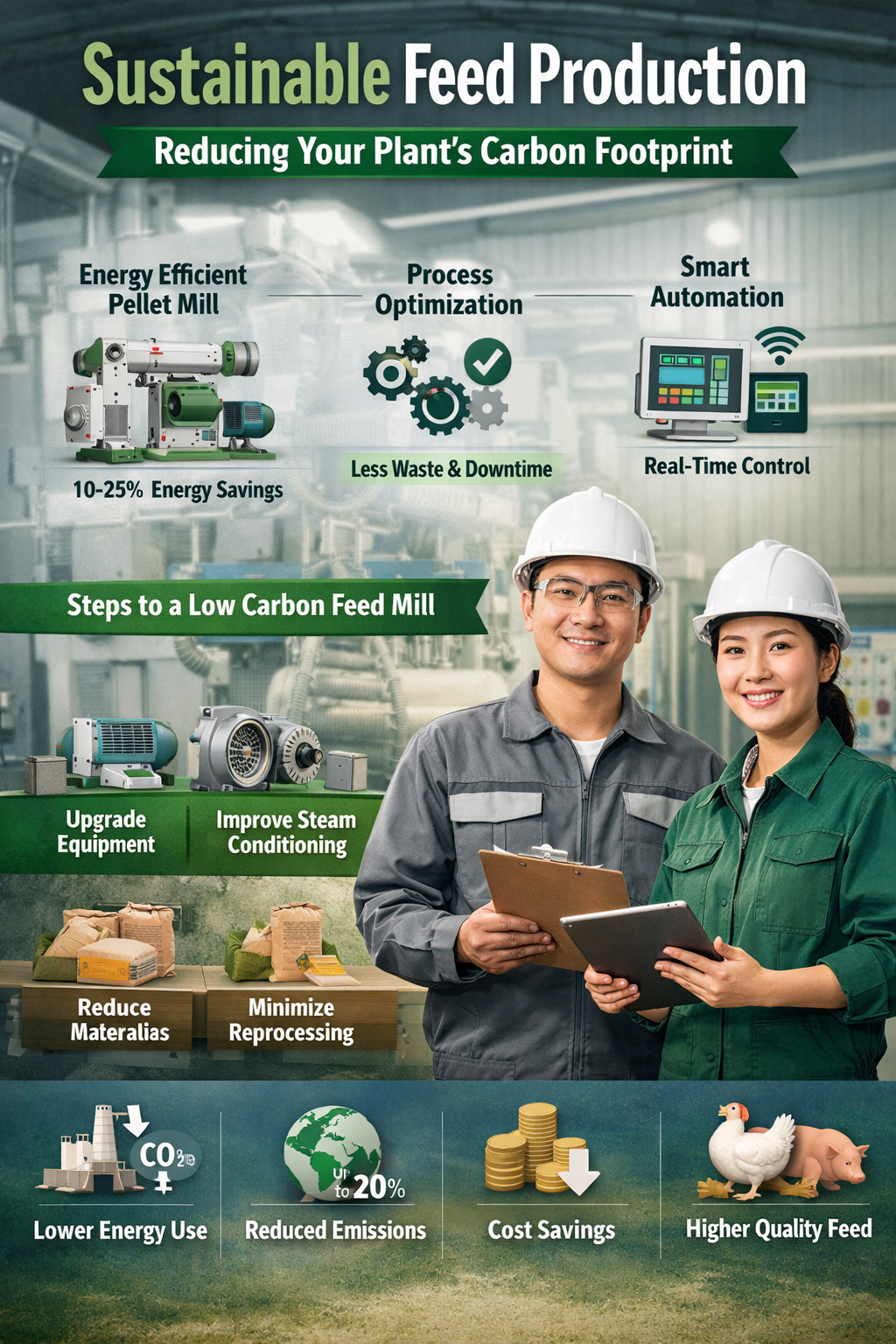
1. The Problem: Why Feed Mills Have a High Carbon Footprint
Feed production is inherently energy-intensive. The primary contributors to carbon emissions in a typical feed mill include:
1.1 High Energy Consumption
l Pelletizing alone can account for 30–50% of total plant energy usage
l Inefficient motors, outdated drives, and poor process control increase electricity demand
1.2 Raw Material Waste
Inconsistent grinding and mixing lead to:
l Nutrient loss
l Increased reprocessing
l Higher material consumption per ton of finished feed
1.3 Thermal Inefficiency
Steam conditioning systems often suffer from:
l Heat loss
l Poor insulation
l Unoptimized moisture control
1.4 Equipment Wear and Downtime
Inefficient machines generate:
l Excess friction → higher energy consumption
l Frequent maintenance → operational inefficiencies
Result: Higher production cost per ton and increased CO₂ emissions per unit output.
2. The Principle: What Drives Sustainable Feed Production
Sustainable feed production is built on three core engineering principles:
2.1 Energy Efficiency per Ton of Output
Reducing kWh consumption per ton of feed is the most direct way to lower emissions.
2.2 Process Optimization
A well-designed process minimizes:
l Material loss
l Rework cycles
l Idle running time
2.3 Lifecycle Equipment Performance
Modern equipment is designed to:
l Maintain efficiency over longer periods
l Reduce wear-related energy spikes
l Enable predictive maintenance
3. The Solution: Practical Strategies to Reduce Carbon Footprint
3.1 Upgrade to Energy Efficient Pellet Mill Systems
The pellet mill is the core energy consumer in any feed plant. Upgrading to an advanced energy efficient pellet mill delivers immediate and measurable benefits.
Key Features to Look For:
l High-efficiency main motors (IE3/IE4 standard)
l Optimized die and roller design for reduced friction
l Variable Frequency Drives (VFD) for load matching
l Advanced lubrication systems to reduce mechanical resistance
Measurable Benefits:
l 0–25% reduction in energy consumption
l Improved pellet durability (PDI)
l Lower maintenance costs
3.2 Optimize Grinding and Particle Size Distribution
Grinding efficiency directly impacts pelletizing performance.
Best Practices:
l Use multi-stage grinding systems
l Optimize hammer mill screen size
l Maintain uniform particle size distribution
Impact:
l Reduced power consumption in pelletizing
l Improved feed conversion ratio (FCR) for end users
l Lower dust generation → reduced waste
3.3 Improve Steam Conditioning Efficiency
Proper conditioning reduces the mechanical energy required during pelletizing.
Key Improvements:
l High-efficiency conditioners with extended retention time
l Automatic moisture control systems
l Steam quality optimization (dry, saturated steam)
Result:
l Lower motor load on pellet mill
l Improved gelatinization → better pellet quality
l Reduced overall energy per ton
3.4 Implement Smart Automation and Process Control
Digitalization is a key enabler of low carbon feed mill operations.
Technologies to Adopt:
l PLC-based centralized control systems
l Real-time energy monitoring
l Load-based equipment control
Benefits:
l Eliminate idle running
l Optimize production scheduling
l Reduce human error
3.5 Reduce Material Waste and Reprocessing
Every reprocessed batch increases energy usage and emissions.
Solutions:
l High-precision batching systems
l Improved mixing uniformity (CV < 5%)
l Real-time quality monitoring
Outcome:
l Less off-spec production
l Reduced raw material loss
l Lower carbon footprint per ton
3.6 Upgrade Auxiliary Systems
Often overlooked, auxiliary systems can significantly impact overall efficiency.
Focus Areas:
l Efficient air compressors (reduce leakage)
l Dust collection systems with optimized airflow
l Conveyor systems with low resistance design
4. Case Insight: What a Low Carbon Feed Mill Looks Like
A modern sustainable feed mill typically achieves:
l Energy consumption: < 20–25 kWh/ton (depending on formula)
l Pelletizing efficiency: > 90%
l Downtime reduction: 15–30%
l CO₂ emissions reduction: up to 20%
This is not achieved through a single upgrade, but through system-wide optimization.
5. Equipment Selection: Key Considerations for Buyers
For international buyers and feed mill investors, selecting the right equipment partner is critical.
5.1 Engineering Capability
Look for suppliers who understand:
l Different raw material profiles (corn, wheat, soybean meal, etc.)
l Regional operating conditions
l Production scale requirements
5.2 Customization
A one-size-fits-all solution often leads to inefficiency. Equipment should be:
l Configured based on your formulation
l Adapted to your capacity and layout
5.3 Lifecycle Support
Sustainable production requires long-term performance:
l Spare parts availability
l Technical support
l Remote diagnostics
6. Strategic Benefits Beyond Sustainability
Investing in sustainable feed production is not just about compliance—it delivers clear business value:
6.1 Cost Reduction
l Lower electricity bills
l Reduced maintenance expenses
6.2 Market Competitiveness
l Meets international sustainability standards
l Enhances brand reputation
6.3 Customer Value
l Higher quality feed improves livestock performance
l Strengthens long-term client relationships
Conclusion
Reducing your plant’s carbon footprint is not a single upgrade—it is a systematic transformation of your feed production process.
By focusing on:
l Energy efficient pellet mill technology
l Process optimization
l Smart automation
l Waste reduction
feed manufacturers can achieve a low carbon, high efficiency production model that is both environmentally responsible and economically advantageous.
In today’s global market, sustainability is increasingly becoming a decisive factor in project selection and supplier evaluation. Companies that invest early in sustainable feed production will not only reduce emissions but also secure a stronger competitive position in the years ahead.