

— A Technical & Commercial Feasibility Analysis Based on Shanghai Zhengyi Machinery Engineering Technology Manufacturing Co., Ltd.
Introduction: The Opportunity Behind the Global Aquafeed Boom
With the continuous expansion of global aquaculture, the floating feed market has entered a stage of sustained and high-quality growth. Fish farming is rapidly shifting from traditional extensive models to intensive, industrialized, and standardized production. This transformation has made high-performance extruded floating fish feed a strategic necessity rather than an optional upgrade.
Against this backdrop, more investors, feed groups, and regional processors are asking a critical question:
Is starting an aquafeed business—especially floating feed production—profitable and technically feasible?
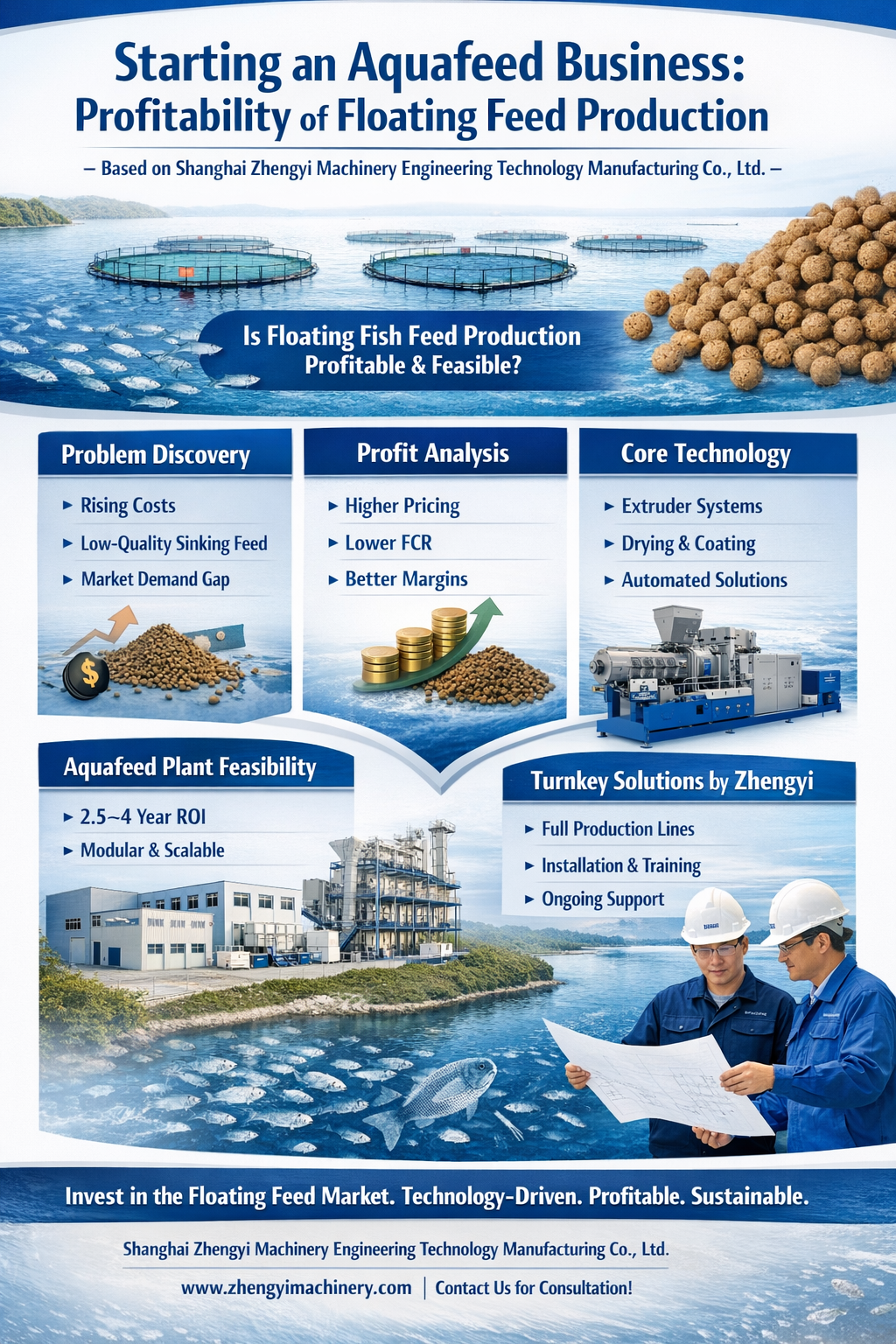
This article, based on the engineering practice and equipment solutions of Shanghai Zhengyi Machinery Engineering Technology Manufacturing Co., Ltd., follows a structured approach of problem discovery → problem analysis → problem solving, providing a professional, data-driven, and search-optimized reference for decision-makers evaluating aquafeed plant feasibility and fish feed business profit potential.
1. Problem Discovery: Why Traditional Feed Models Are Losing Competitiveness
1.1 Rising Pressure on Aquaculture Profitability
Aquaculture producers worldwide are facing multiple challenges:
l Increasing raw material costs
l Tightening environmental regulations
l Higher expectations for feed conversion ratio (FCR)
l Demand for consistent pellet quality and water stability
Traditional sinking feed and simple pelleting technologies struggle to meet these requirements, leading to higher feed waste, poor digestibility, and water pollution—directly eroding farmers’ margins.
1.2 Structural Gaps in the Feed Supply Market
In many emerging aquaculture regions, the local feed supply still relies on:
l Low-density sinking feed
l Inconsistent pellet size and durability
l Limited nutritional precision
This gap has created strong demand for floating extruded aquafeed, opening a clear entry window for new, technically capable producers.
2. Problem Analysis: Profitability Logic of Floating Fish Feed Production
2.1 Why Floating Feed Commands Higher Margins
From a commercial perspective, fish feed business profit is not determined by output volume alone, but by value density. Floating feed offers several margin-enhancing advantages:
l Premium Pricing Capability
Floating feed typically sells at 15–35% higher prices than conventional sinking feed due to its functional benefits.
l Lower Feed Conversion Ratio (FCR)
Improved digestibility and controlled feeding reduce feed waste, allowing farmers to accept higher feed prices while lowering overall production costs.
l Brand Differentiation
Feed manufacturers offering stable floating pellets can position themselves as technology-driven suppliers rather than commodity producers.
2.2 Cost Structure of an Extruded Aquafeed Plant
A feasibility assessment shows that while extrusion lines require higher initial investment, the long-term economics are favorable:
l Equipment depreciation per ton decreases significantly at scale
l Energy consumption is offset by higher selling prices
l Automated lines reduce labor dependency
Shanghai Zhengyi’s engineering data indicate that a medium-scale floating feed plant can achieve gross margins of 18–30%, depending on formulation and regional market conditions.
3. Core Technology: Why Extrusion Is the Industry Standard
3.1 Technical Advantages of Extruded Floating Feed
Extrusion technology enables precise control over:
l Pellet density and buoyancy
l Starch gelatinization
l Oil absorption and surface coating
l Pellet durability and uniformity
These parameters are impossible to stabilize consistently using traditional pellet mills.
3.2 Key Equipment in a Floating Feed Production Line
Based on Shanghai Zhengyi Machinery’s turnkey project experience, a standard extruded aquafeed line includes:
l Raw Material Grinding System
Fine and uniform particle size is critical for extrusion stability.
l Intelligent Batching & Mixing System
Ensures nutritional accuracy and repeatability.、
l Twin-Screw or High-Performance Single-Screw Extruder
The core of floating feed production, responsible for expansion, cooking, and shaping.
l Drying & Cooling System
Controls moisture and structural stability.
l Vacuum Coating System
Enhances oil absorption without surface leakage.
Automated Packing & Storage Solutions
Shanghai Zhengyi designs these systems as integrated engineering solutions, rather than standalone machines, ensuring process compatibility and long-term reliability.
4. Aquafeed Plant Feasibility: From Concept to Reality
4.1 Technical Feasibility
Shanghai Zhengyi’s project cases demonstrate that modern aquafeed plants can be:
l Modular and scalable
l Adaptable to fish, shrimp, and specialty species
l Designed for continuous 24/7 operation
Engineering feasibility is no longer a bottleneck—the key lies in proper system configuration and formulation alignment.
4.2 Economic Feasibility
A typical floating feed project shows:
l Payback period: 2.5–4 years
l High utilization of local raw materials
l Strong resistance to market price fluctuations due to premium positioning
This confirms that aquafeed plant feasibility is increasingly attractive, especially in regions with growing aquaculture output but limited high-end feed supply.
5. Problem Solving: How Shanghai Zhengyi Delivers Sustainable Value
5.1 Engineering-Driven Equipment Manufacturing
Shanghai Zhengyi Machinery Engineering Technology Manufacturing Co., Ltd. positions itself not merely as an equipment supplier, but as a process engineering partner. Its strengths include:
l Deep understanding of feed formulation and extrusion behavior
l Customized line design based on species and capacity
l Emphasis on operational stability and maintenance efficiency
5.2 Turnkey Solutions for New Feed Investors
For clients starting an aquafeed business, Zhengyi provides:
l Feasibility analysis and capacity planning
l Complete floating feed production lines
l Installation, commissioning, and operator training
l Long-term technical support and upgrades
This reduces entry risk and accelerates time-to-market for new producers.
6. Strategic Outlook: The Future of the Floating Feed Market
Global demand for high-quality aquafeed will continue to rise, driven by:
l Expansion of intensive aquaculture
l Sustainability and feed efficiency requirements
l Digitalized farm management
Floating feed, supported by extrusion technology, will remain the dominant growth segment. Manufacturers who invest early in advanced equipment and engineering alignment will secure long-term competitive advantages.
Conclusion
Starting an aquafeed business focused on floating feed production is no longer a speculative venture—it is a data-supported, technology-validated industrial opportunity. While extrusion lines require higher upfront investment, their superior margins, scalability, and market resilience make them the backbone of modern aquafeed manufacturing.
With its engineering expertise and complete equipment solutions, Shanghai Zhengyi Machinery Engineering Technology Manufacturing Co., Ltd. stands as a reliable partner for investors and feed producers seeking sustainable growth in the global floating feed market.
For companies evaluating fish feed business profit, floating feed market positioning, or aquafeed plant feasibility, the conclusion is clear:
Technology first, engineering aligned, value follows.
For technical consultations, plant planning, or quotation inquiries, Shanghai Zhengyi Machinery welcomes discussions with global aquafeed professionals and investors.