

Introduction: From “Low Cost” to “High Value”
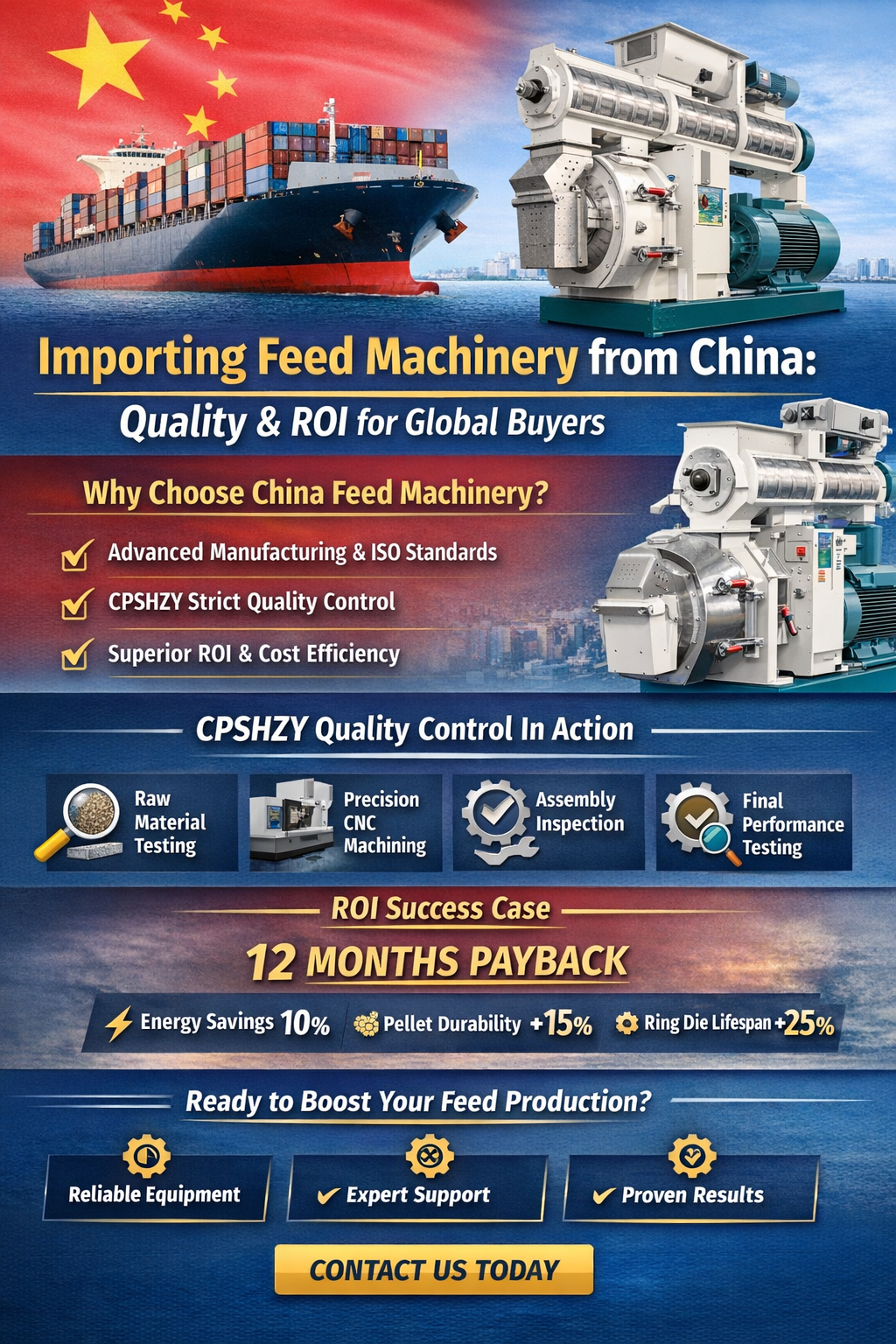
Over the past two decades, China has evolved from a low-cost manufacturing hub into a global leader in industrial equipment production. Nowhere is this transformation more evident than in the feed machinery sector. Today, global buyers—from Southeast Asia to Africa, the Middle East, and Latin America—are increasingly choosing to import pellet mills from China and partner with a reliable China feed machinery manufacturer.
Yet, one concern still lingers in many buyers’ minds:
“Can Chinese feed machinery truly deliver consistent quality and long-term return on investment (ROI)?”
This article addresses that question head-on. We will explore:
l The real quality standards behind modern Chinese feed machinery
l How companies like CPSHZY implement strict quality control systems
l Why importing from China can deliver superior ROI—not just lower cost
l What global buyers should evaluate before making a purchase decision
1. The Evolution of China Feed Machinery Manufacturing
In the early 2000s, Chinese machinery was often associated with affordability—but also inconsistency. However, the landscape has dramatically changed.
Key Upgrades in the Industry:
l Advanced CNC machining and automation
l Adoption of European design principles
l Integration of ISO-certified quality systems
l Export-driven improvements based on global customer feedback
Today, leading Chinese manufacturers are no longer competing on price alone—they are competing on performance, durability, and lifecycle value.
For buyers looking to import pellet mills from China, this shift means one thing:
�� You are no longer choosing between cheap vs. reliable
�� You are choosing between good vs. better ROI
2. Understanding Quality: What Really Matters in Feed Machinery
When evaluating a China feed machinery manufacturer, quality is not a vague concept—it is measurable.
2.1 Core Quality Factors
1. Material Selection
l High-grade alloy steel for ring dies
l Wear-resistant rollers
l Precision bearings (SKF / NSK equivalent)
2. Manufacturing Accuracy
l CNC machining tolerance
l Dynamic balancing of rotating components
l Assembly precision
3. Process Stability
l Uniform conditioning
l Stable pellet formation
l Reduced vibration and noise
4. Durability & Wear Resistance
l Ring die lifespan
l Roller shell longevity
l Reduced maintenance frequency
3. CPSHZY Quality Control: A System, Not a Slogan
When discussing CPSHZY quality control, it is important to understand that quality is not inspected at the end—it is built into every step.
3.1 Multi-Stage Quality Control System
1. Raw Material Inspection
l Chemical composition testing
l Hardness verification
l Supplier traceability
2. In-Process Control
l Real-time machining monitoring
l Dimensional inspection at each stage
l Heat treatment consistency checks
3. Assembly Validation
l Alignment calibration
l Torque verification
l Load simulation testing
4. Final Testing
l Trial runs under real production conditions
l Pellet quality evaluation (PDI, durability)
l Capacity verification
3.2 Why This Matters for Buyers
For global customers, this translates into:
l Lower failure rates
l Consistent pellet quality
l Predictable maintenance cycles
l Reduced downtime risk
In other words:
�� Quality is not just about the machine—it’s about operational reliability
4. Cost vs. ROI: The Real Decision Metric
Many buyers initially focus on purchase price. However, experienced operators know:
The true cost of a pellet mill is determined over its lifetime—not at purchase.
4.1 Total Cost of Ownership (TCO)
When you import a pellet mill from China, consider:
|
Cost Factor |
Impact |
|
Initial Purchase Price |
One-time |
|
Energy Consumption |
Ongoing |
|
Spare Parts Replacement |
Recurring |
|
Maintenance Labor |
Recurring |
|
Downtime Loss |
High impact |
|
Production Efficiency |
Revenue driver |
4.2 Where Chinese Machinery Wins
Modern Chinese manufacturers deliver strong ROI through:
1. Competitive Initial Investment
20–40% lower than European equivalents
2. Comparable Performance
l Similar output capacity
l Stable pellet quality
3. Faster Payback Period
Typically 6–18 months, depending on production scale
4. Lower Spare Parts Cost
Ring dies and rollers at significantly lower cost
Faster availability
5. Performance Case: Pellet Mill ROI in Practice
Let’s consider a typical scenario:
Buyer Profile:
Medium-scale feed mill
l Capacity: 5–10 TPH\
l Location: Southeast Asia / Africa
Investment:
Pellet mill imported from China
Results:
l Energy consumption reduced by 8–12%
l Pellet durability improved by 10–15%
l Ring die lifespan extended by 20–30%
l ROI achieved within 12 months
6. Addressing Common Concerns
Concern 1: “Will quality be consistent?”
Answer:
With a manufacturer implementing structured systems like CPSHZY quality control, consistency is no longer an issue. The key is selecting the right supplier, not avoiding China altogether.
Concern 2: “What about after-sales service?”
Modern Chinese suppliers now provide:
l Remote technical support
l Installation guidance
l Spare parts planning
l On-site commissioning (if required)
Concern 3: “Is communication a barrier?”
Top exporters now offer:
l Fluent English technical teams
l Clear documentation
l Fast response times (often within 24 hours)
7. How to Choose the Right China Feed Machinery Manufacturer
Not all suppliers are equal. Here’s how to evaluate effectively:
7.1 Key Evaluation Criteria
1. Export Experience
l Years in international markets
l Reference projects
2. Engineering Capability
l Ability to customize solutions
l Understanding of raw material variations
3. Quality System Transparency
l Factory audits
l Inspection reports
l Test data availability
4. Technical Support
l Pre-sales consultation
l Process optimization advice
7.2 Red Flags to Avoid
Extremely low pricing without technical justification
l Lack of testing or trial reports
l No clear spare parts strategy
l Poor communication responsiveness
8. Beyond Machinery: Value-Added Services
Leading suppliers today offer more than just equipment.
Value-Added Capabilities:
Process design optimization
l Feed formulation insights
l Line layout planning
l Automation integration
l Energy efficiency consulting
This transforms the relationship from:
�� Supplier → Buyer
into
�� Partner → Long-term growth
9. Future Trends: Why China Will Lead Further
The trajectory is clear. Chinese feed machinery manufacturers are investing in:
l Smart manufacturing (Industry 4.0)
l Digital monitoring systems
l Energy-efficient designs
l AI-driven process optimization
For global buyers, this means:
�� Early adopters gain competitive advantage
Conclusion: Smart Buyers Focus on Value, Not Just Price
Importing feed machinery is no longer a risky decision—it is a strategic one.
Choosing a qualified China feed machinery manufacturer and leveraging systems like CPSHZY quality control allows buyers to achieve:
Reliable production performance
Lower operational costs
Faster ROI
Long-term competitiveness
The question is no longer:
“Should I import from China?”
The real question is:
“Which Chinese partner will maximize my ROI?”
Call to Action
If you are planning to import a pellet mill from China or upgrade your existing production line, we can help you:
l Evaluate your current process
l Recommend the most suitable equipment
l Provide a tailored ROI analysis
l Support your project from design to commissioning
�� Contact us today to explore how we can improve your feed production efficiency and profitability.