

In the global feed and biomass industries, choosing the right pellet mill is not simply a matter of budget — it directly determines production efficiency, product quality, operational stability, and long-term return on investment.
When evaluating flat die vs ring die pellet mills, buyers often ask:
l Which design delivers better pellet quality?
l Is a small pellet mill sufficient for commercial expansion?
l Why is a vertical ring die pellet mill considered the standard for large feed plants?
This comprehensive technical comparison explains the structural principles, operational characteristics, scalability, and commercial suitability of both pellet mill types — helping you make an informed investment decision.
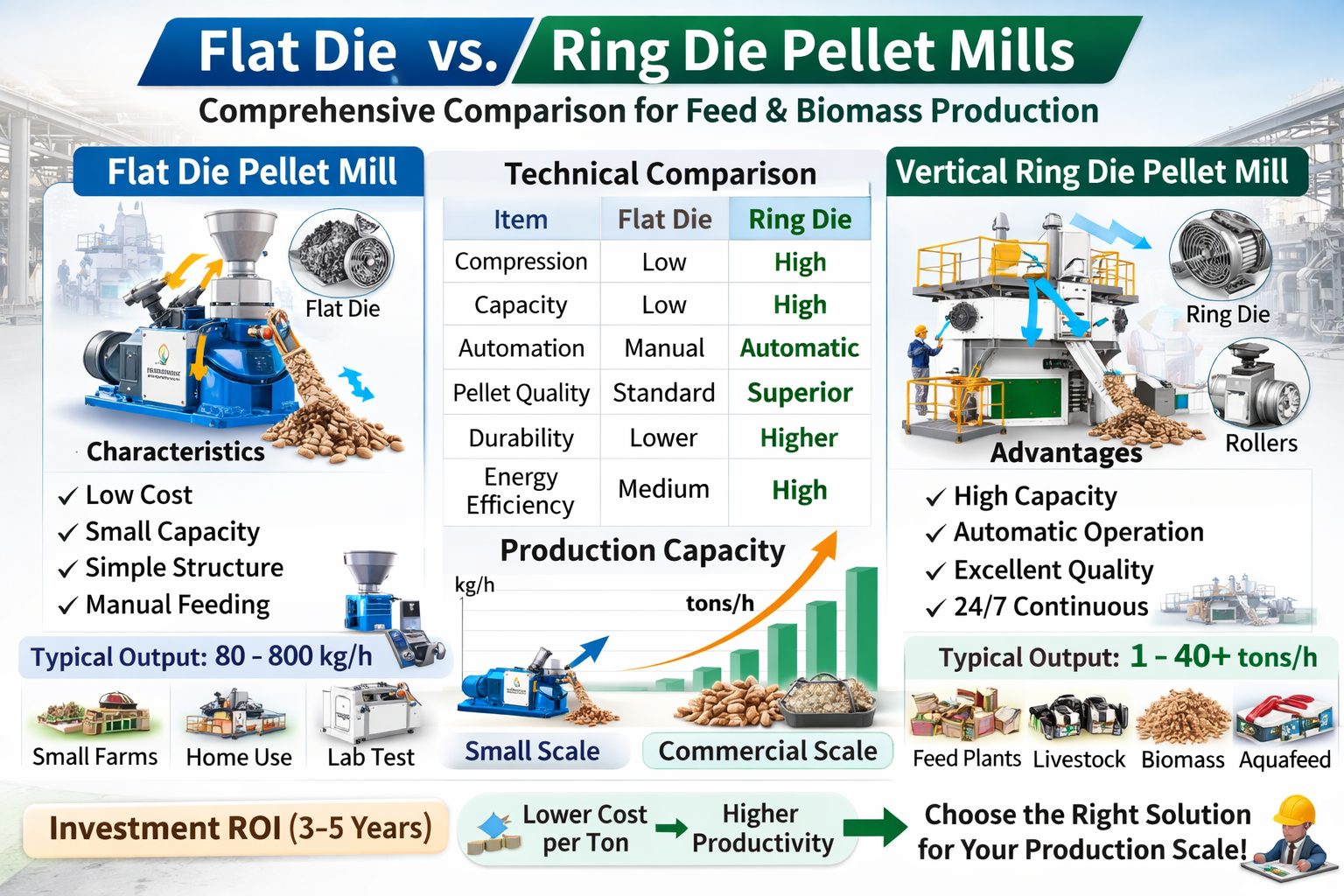
1. Structural Overview: How Each Pellet Mill Works
Flat Die Pellet Mill
A flat die pellet mill features a horizontally mounted flat die plate with multiple perforations. One or two rollers rotate above the die, pressing material downward through the holes to form pellets.
Core Characteristics:
Simple mechanical structure
l Lower compression ratio
l Manual or semi-automatic feeding
l Suitable for low throughput operations
Flat die systems are widely used in:
l Small livestock farms
l Household feed production
l Laboratory testing
l Small-scale biomass pelletizing
Because of their mechanical simplicity, they are commonly categorized as small pellet mills.
Ring Die Pellet Mill
A ring die pellet mill uses a cylindrical die ring with radial holes. Rollers press material outward against the inner wall of the rotating die ring, forcing it through under high pressure.
In a vertical ring die pellet mill, material flows vertically into the die chamber, improving distribution uniformity and reducing mechanical stress.
Core Characteristics:
l High compression ratio
l Continuous automatic feeding
l Superior heat retention
l Designed for heavy-duty operation
Ring die systems are standard in:
l Commercial feed mills
l Integrated livestock corporations
l Industrial biomass pellet plants
l Aquafeed production lines
2. Technical Comparison: Flat Die vs Ring Die
2.1 Compression Efficiency & Pellet Density
The compression ratio determines pellet hardness and durability.
l Flat die: Lower pressure, shorter compression path → suitable for soft materials
l Ring die: Higher pressure, longer compression path → produces dense, durable pellets
For commercial feed plants where pellet durability index (PDI) directly affects transportation and storage losses, ring die systems deliver superior consistency.
2.2 Production Capacity
Capacity is the most decisive factor in industrial applications.
|
Parameter |
Flat Die Pellet Mill |
Ring Die Pellet Mill |
|
Typical Output |
80–800 kg/h |
1–40+ tons/h |
|
Power Range |
5–30 kW |
55–355+ kW |
|
Operation |
Intermittent |
Continuous |
|
Automation |
Limited |
Fully automatic |
For farms producing feed for internal use, a small pellet mill is adequate.
However, for commercial sales or large integrated farms, flat die capacity becomes a bottleneck.
2.3 Durability & Maintenance
Flat die machines:
l Faster die wear
l Frequent roller adjustments
l Shorter service life under heavy load
Ring die machines:
l Precision alloy die rings
l Optimized roller geometry
l Longer maintenance intervals
l Designed for 24/7 operation
A properly maintained vertical ring die pellet mill can operate continuously with predictable maintenance scheduling — critical for commercial feed plants.
2.4 Heat & Conditioning Performance
Pellet quality depends heavily on conditioning — moisture, temperature, and starch gelatinization.
Ring die systems integrate:
l Steam conditioners
l Variable frequency feeders
l Optimized airflow systems
Flat die systems generally lack advanced conditioning integration, limiting pellet quality for high-protein or aquafeed formulas.
2.5 Energy Efficiency
Although ring die mills require higher installed power, their energy consumption per ton is typically lower at scale.
Flat die mills may appear cost-effective initially but become inefficient at higher volumes due to:
l Repeated restarts
l Lower throughput
l Increased manual labor
3. Why Ring Die Pellet Mills Dominate Commercial Production
3.1 Scalability
Commercial feed production demands:
l Stable throughput
l Uniform pellet size
l Low downtime
l Integrated automation
Only ring die systems meet these requirements consistently.
3.2 Consistent Pellet Quality
In large-scale operations, pellet quality affects:
l Feed conversion ratio (FCR)
l Animal growth performance
l Brand reputation
l Export compliance
Ring die compression ensures:
l Higher pellet density
l Lower fines percentage
l Improved durability
4. When a Flat Die Pellet Mill Is the Right Choice
Despite industrial advantages of ring dies, flat die pellet mills still serve important roles.
They are ideal for:
l Small family farms
l On-site feed production
l Budget-constrained startups
l Trial pellet formulation testing
For customers producing less than 1 ton per hour without commercial distribution plans, a flat die solution can be economically rational.
5. Vertical Ring Die Pellet Mill: Structural Advantages
The vertical ring die pellet mill has become increasingly popular due to:
l Gravity-assisted feeding
l Even material distribution
l Reduced bearing load
l Lower vibration
l Improved die lifespan
This design minimizes mechanical stress compared to some horizontal models, enhancing operational stability.
6. Investment Perspective: Short-Term Cost vs Long-Term ROI
Initial Investment
l Flat die: Lower purchase price
l Ring die: Higher capital cost
Operational Reality
Over 3–5 years, ring die systems provide:
l Lower cost per ton
l Higher output value
l Reduced labor dependency
l Greater automation compatibility
l Stronger resale value
For investors targeting commercial feed markets, ring die mills offer significantly stronger long-term returns.
7. Application-Based Recommendation Guide
|
Application |
Recommended Type |
|
Household poultry farm |
Flat Die |
|
Small cattle farm |
Flat Die |
|
Regional feed distributor |
Ring Die |
|
Integrated livestock company |
Ring Die |
|
Aquafeed plant |
Ring Die |
|
Biomass pellet plant |
Ring Die |
8. Key Selection Considerations Before Purchase
Before choosing between flat die vs ring die pellet mills, evaluate:
l Target production capacity
l Raw material characteristics
l Power supply availability
l Expansion plan (3–5 years)
l Automation requirements
l Local maintenance capability
A pellet mill should not only meet today’s needs — it must support tomorrow’s growth.
9. Conclusion: Matching Technology with Production Scale
The debate of flat die vs ring die is not about which machine is “better” — it is about which is technically appropriate for your production scale.
Flat die pellet mills are practical for small farms and entry-level users.
Ring die pellet mills, especially the vertical ring die pellet mill, are essential for commercial, industrial, and export-oriented production.
If your objective is consistent pellet quality, operational reliability, and scalable profitability, the ring die solution is the industry-proven choice.
Looking for the Right Pelletizing Solution?
Selecting the proper pellet mill requires technical evaluation, not guesswork.
Our engineering team provides:
l Capacity assessment
l Raw material analysis
l Die configuration optimization
l Energy efficiency calculation
l Full production line integration
Whether you require a small pellet mill for farm use or a fully automated vertical ring die pellet mill for commercial feed manufacturing, we are ready to support your project with technically sound, long-term solutions.
Contact us today to discuss your production goals and receive a tailored proposal.