

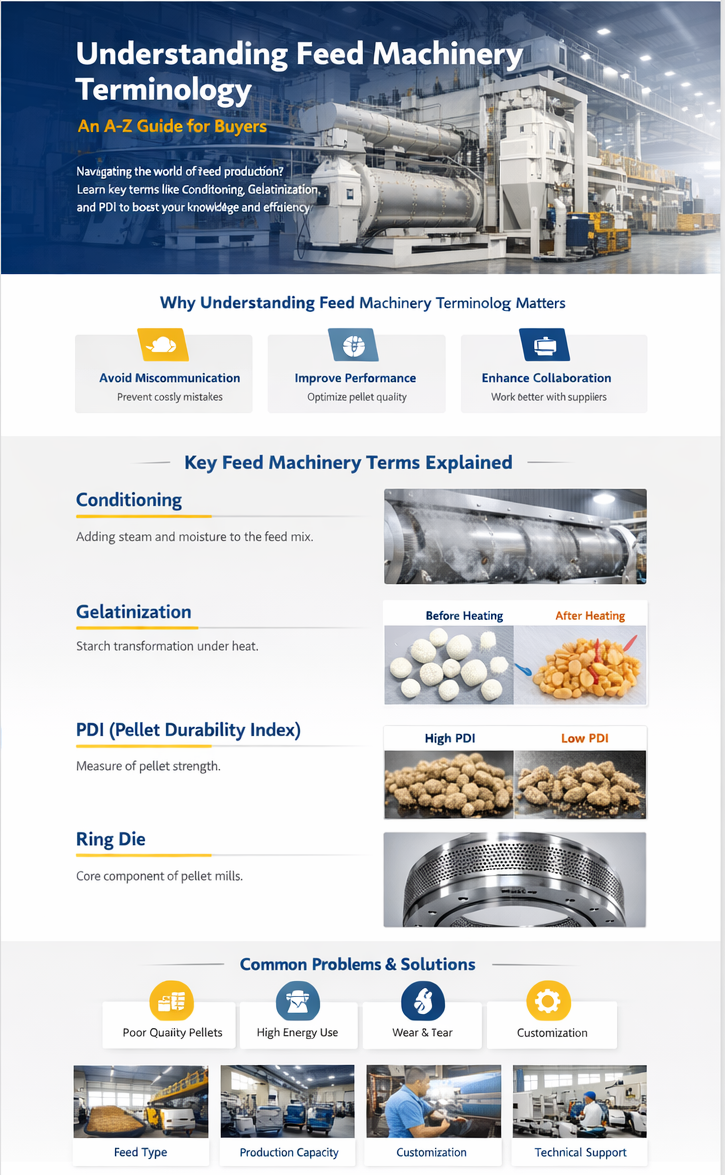
Introduction
In the global feed manufacturing industry, clear communication is essential for successful procurement and equipment performance. However, many buyers—especially those new to pellet production—often struggle with technical jargon such as conditioning, gelatinization, and PDI.
This guide provides a practical A–Z overview of feed machinery terminology, helping international buyers better understand the pelletizing process, make informed purchasing decisions, and optimize production efficiency.
Whether you are sourcing pellet mill ring dies, evaluating feed machinery, or improving your production line, this glossary will serve as a valuable reference.
Why Understanding Feed Machinery Terminology Matters
1. Avoid Costly Miscommunication
Incorrect technical understanding can lead to:
-
Wrong equipment selection
-
Poor pellet quality
-
Increased maintenance costs
2. Improve Equipment Performance
Knowing key parameters allows buyers to:
-
Optimize pellet durability
-
Improve feed conversion ratios
-
Reduce downtime
3. Enhance Supplier Collaboration
Clear terminology ensures smoother communication between:
-
Buyers
-
Engineers
-
Equipment manufacturers
Key Feed Machinery Terms Explained (A–Z Selection)
C – Conditioning
Definition:
Conditioning refers to the process of adding steam and moisture to raw materials before pelletizing.
Principle:
Steam softens feed particles, improving binding ability and reducing mechanical resistance during compression.
Why It Matters:
-
Improves pellet quality
-
Reduces energy consumption
-
Extends ring die lifespan
Practical Tip:
Ensure proper temperature (typically 75–85°C) and moisture levels for optimal results.
G – Gelatinization
Definition:
Gelatinization is the process where starch granules absorb water and swell when heated, forming a gel-like structure.
Principle:
During conditioning, heat and moisture break down starch crystalline structures.
Why It Matters:
-
Enhances feed digestibility
-
Improves pellet durability
-
Increases animal nutrient absorption
Common Issue:
Insufficient gelatinization leads to weak pellets and poor feed efficiency.
P – Pellet Durability Index (PDI)
Definition:
PDI measures the strength and durability of pellets during handling and transportation.
Principle:
Pellets are mechanically tested to determine resistance to breakage.
Why It Matters:
-
High PDI = less dust, better quality
-
Low PDI = product loss and customer complaints
Target Range:
A good PDI is typically above 90% depending on feed type.
R – Ring Die
Definition:
A ring die is a critical component in pellet mills, responsible for shaping feed into pellets.
Key Parameters:
-
Hole diameter
-
Compression ratio
-
Material (e.g., alloy steel, stainless steel)
Why It Matters:
-
Directly affects pellet quality
-
Determines production efficiency
-
Influences machine lifespan
Buyer Tip:
Choose a ring die based on raw material characteristics and desired pellet size.
C – Compression Ratio
Definition:
The ratio between the effective hole length and diameter of the die.
Formula Concept:
Higher ratio = stronger compression
Impact:
-
High ratio → harder pellets, lower output
-
Low ratio → softer pellets, higher output
Optimization Advice:
Balance durability and productivity according to your feed formula.
F – Feed Rate
Definition:
The speed at which raw materials enter the pellet mill.
Why It Matters:
-
Too high → blockage and uneven pellets
-
Too low → reduced efficiency
Best Practice:
Maintain a stable and consistent feed rate.
S – Steam Quality
Definition:
Steam used in conditioning must be dry and saturated.
Impact:
-
Poor steam → uneven conditioning
-
Good steam → better gelatinization and pellet quality
W – Wear Resistance
Definition:
The ability of components (especially ring dies) to resist wear during operation.
Why It Matters:
-
Determines maintenance frequency
-
Affects long-term production cost
Solution:
Use high-quality materials and proper heat treatment.
Common Problems and Solutions in Pellet Production
Problem 1: Low Pellet Quality
Cause:
-
Poor conditioning
-
Incorrect compression ratio
Solution:
-
Optimize steam addition
-
Adjust die specifications
Problem 2: High Energy Consumption
Cause:
-
Improper raw material preparation
-
Worn ring die
Solution:
-
Improve grinding process
-
Replace or upgrade ring die
Problem 3: Short Equipment Lifespan
Cause:
-
Low-quality components
-
Incorrect operation
Solution:
-
Use high-grade ring dies
-
Follow maintenance standards
How to Choose the Right Feed Machinery and Components
When selecting feed equipment, especially ring dies, buyers should consider:
1. Raw Material Type
-
Corn-based feed
-
Biomass materials
-
Animal feed formulations
2. Production Capacity
-
Small-scale vs industrial production
3. Technical Support
-
Supplier expertise
-
After-sales service
4. Customization Capability
-
Tailored compression ratios
-
Specialized hole designs
Our Expertise in Feed Machinery Solutions
At CP M&E, we specialize in:
-
High-performance pellet mill ring dies
-
Customized solutions for global feed producers
-
Advanced heat treatment technology
Our products are widely used in:
-
Southeast Asia
-
South America
-
Middle East markets
We focus on delivering:
-
Stable performance
-
Longer service life
-
Consistent pellet quality
Conclusion
Understanding feed machinery terminology is not just about technical knowledge—it directly impacts production efficiency, product quality, and long-term profitability.
By mastering key concepts such as conditioning, gelatinization, and PDI, buyers can:
-
Make smarter purchasing decisions
-
Optimize pellet production
-
Build stronger partnerships with suppliers
As the feed industry continues to evolve globally, having a solid technical foundation will be a critical competitive advantage.
Looking for high-quality ring dies for your pellet mill?
Contact us today for customized solutions and technical support.