

Dry Type vs. Wet Type Fish Feed Extruders: Making the Right Choice
Aquaculture is one of the fastest-growing sectors in global food production. As fish farming expands, the demand for high-quality floating fish feed continues to increase. At the center of this process is a key piece of equipment: the fish feed extruder.
For feed producers planning a new production line—or upgrading an existing one—one of the most common questions is:
Should you choose a dry type fish feed extruder or a wet type fish feed extruder?
Both machines are widely used to produce floating or sinking aquatic feed, but they differ significantly in capacity, energy consumption, steam requirements, investment cost, and production scale. Making the right choice can directly affect your production efficiency, operating cost, and final feed quality.
This article provides a practical comparison between dry type vs wet type fish feed extruder, helping aquaculture businesses select the most suitable equipment for their operations.
What Is a Fish Feed Extruder?
A fish feed extruder is a machine that processes feed ingredients—such as fish meal, soybean meal, corn flour, and vitamins—into nutritionally balanced pellets through a combination of high temperature, high pressure, and mechanical shear.
During extrusion:
- Raw materials are mixed and fed into the extruder.
- The screw compresses and cooks the material.
- The material passes through a die.
- Pressure drops suddenly at the die outlet.
- The pellets expand and float.
This process improves:
l Feed digestibility
l Pellet stability in water
l Floating performance
l Nutrient availability
Fish feed extruders are mainly divided into two categories:
l Dry Type Fish Feed Extruder
l Wet Type Fish Feed Extruder
Dry Type Fish Feed Extruder
How Dry Type Extruders Work
A dry type fish feed extruder relies mainly on mechanical friction and electric heating to cook the feed materials. The high-speed screw generates heat through compression and shear.
Unlike wet extruders, no external steam boiler is required.
Key Characteristics
l No steam system needed
l Compact structure
l Lower initial investment
l Easy installation and operation
l Suitable for small to medium production
Typical Capacity Range
Dry type extruders usually produce:
100 kg/h – 1,500 kg/h
Depending on the model and motor power.
Advantages
1. Lower Investment Cost
Dry extruders are generally more affordable. For new or small feed mills, the floating fish feed machine price is significantly lower than wet systems.
2. Simple Installation
Since there is no boiler or steam pipeline, installation is straightforward. Many small factories can start production quickly.
3. Flexible Operation
Operators can start or stop the machine easily without waiting for steam pressure.
4. Ideal for Small Feed Producers
Dry extruders are commonly used by:
l Small aquaculture farms
l Start-up feed factories
l Local feed suppliers
l Experimental feed production
Limitations
However, dry type extruders also have some limitations.
1. Lower Production Capacity
The production output is relatively limited compared to wet extrusion systems.
2. Slightly Lower Pellet Stability
Because there is no steam pre-conditioning, feed cooking may be less uniform.
3. Higher Electrical Load
All heat must be generated through mechanical energy, which can increase electricity consumption per ton of feed.
Wet Type Fish Feed Extruder
How Wet Type Extruders Work
A wet type fish feed extruder uses steam injection from a boiler to pre-cook the raw materials before extrusion.
The process includes:
- Steam conditioning
- Moisture adjustment
- Extrusion cooking
- Pellet expansion
The combination of steam heat and mechanical energy improves starch gelatinization and feed texture.
Key Characteristics
l Requires steam boiler
l Higher production capacity
l More stable pellet quality
l Suitable for industrial feed plants
Typical Capacity Range
Wet extruders can typically produce:
1 ton/hour – 20 tons/hour or more
This makes them the preferred solution for large commercial feed mills.
Advantages
1. Higher Production Efficiency
With steam pre-conditioning, materials are partially cooked before entering the extruder. This reduces mechanical load and improves throughput.
2. Better Pellet Quality
Wet extrusion allows:
l Better starch gelatinization
l More uniform cooking
l Improved pellet durability
l Stable floating performance
3. Lower Energy Consumption per Ton
Although wet systems require a boiler, the combined steam and mechanical heating is often more energy-efficient in large-scale production.
4. Ideal for Large Feed Mills
Wet extruders are commonly used by:
l Industrial aquafeed factories
l Integrated aquaculture companies
l Export-oriented feed producers
Limitations
1. Higher Initial Investment
Wet extrusion systems require additional equipment:
l Steam boiler
l Steam pipes
l Conditioning system
l More complex control system
2. More Space Required
The entire production line is larger than a dry system.
3. Skilled Operation Needed
Operators must manage steam pressure, moisture levels, and temperature.
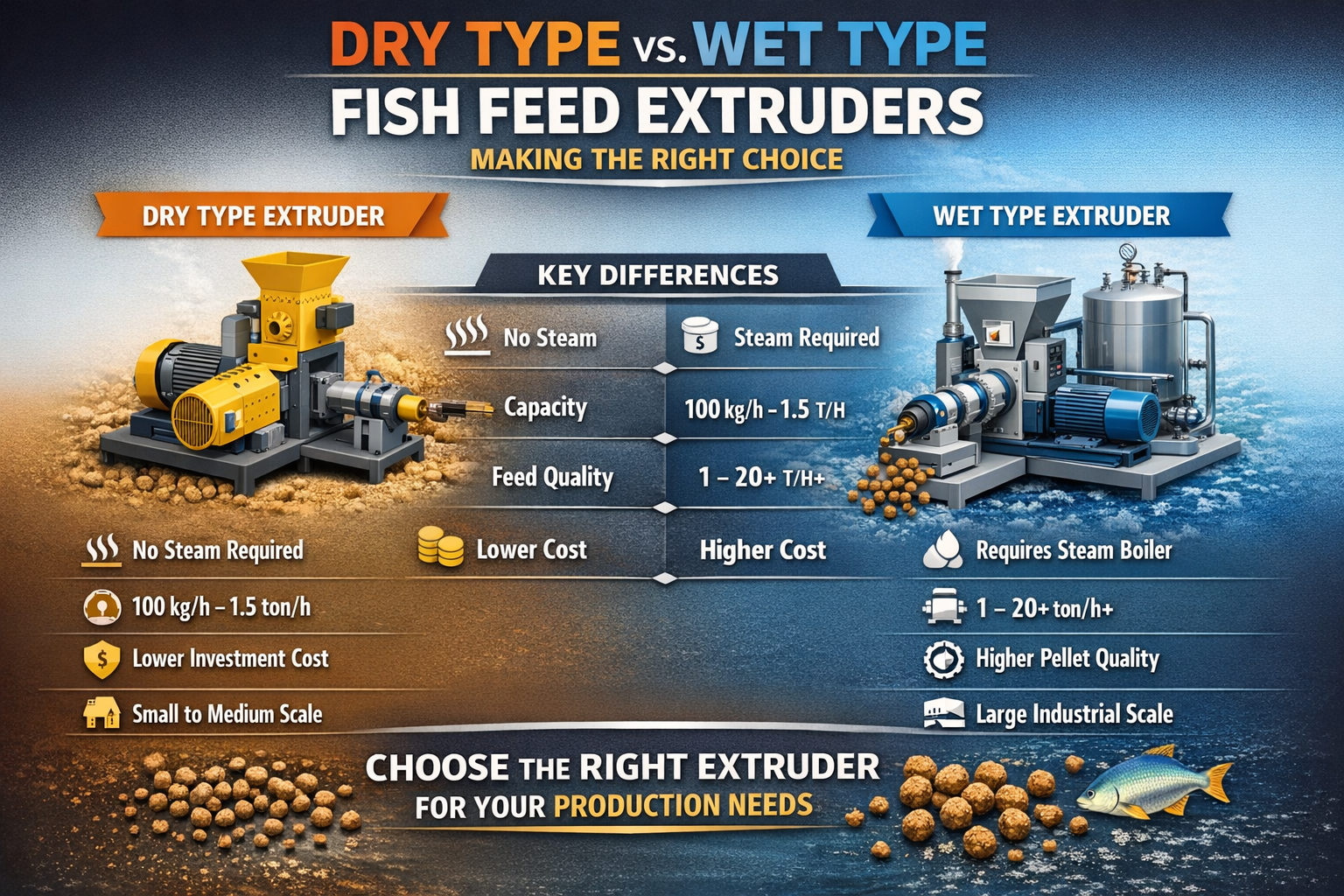
Dry Type vs. Wet Type Fish Feed Extruder: Key Differences
The most important differences between the two systems can be summarized in the following areas.
1. Steam Requirement
Dry Type Extruder
l No steam required
l Heat generated by mechanical friction
Wet Type Extruder
l Requires steam boiler
l Steam pre-conditioning improves cooking efficiency
2. Production Capacity
Dry Type
100 kg/h – 1.5 ton/h
Wet Type
1 ton/h – 20 ton/h+
Wet extruders are designed for industrial-scale production.
3. Feed Quality
Dry Type
l Good pellet quality
l Suitable for standard floating feed
Wet Type
l Superior pellet durability
l More uniform cooking
l Better expansion control
4. Investment Cost
Dry Type Fish Feed Extruder
Lower floating fish feed machine price, making it attractive for new businesses.
Wet Type Fish Feed Extruder
Higher capital investment due to steam system and larger equipment.
5. Energy Consumption
Dry Type
Higher electrical consumption per ton.
Wet Type
Better energy efficiency at large production volumes.
How to Choose the Right Fish Feed Extruder
Choosing between dry type vs wet type fish feed extruder depends on several practical factors.
1. Production Scale
If your target production is:
l Below 1 ton/hour → Dry type extruder
l Above 2 tons/hour → Wet type extruder
2. Budget
For businesses with limited startup capital, a dry type floating fish feed machine is often the best entry point.
Large companies aiming for long-term industrial production should invest in a wet extrusion system.
3. Infrastructure
If your factory already has:
l Steam boiler
l Industrial utilities
l Large production space
Then a wet type extruder can maximize efficiency.
4. Feed Quality Requirements
High-performance aquaculture species such as:
l Salmon
l Shrimp
l High-density tilapia farms
often benefit from wet extrusion technology due to better pellet consistency.
Industry Trend: Moving Toward Automated Aquafeed Lines
In recent years, modern aquafeed plants are increasingly adopting fully automated extrusion production lines, which may include:
l Grinding systems
l Automatic batching
l Steam conditioning
l Twin-screw extrusion
l Drying and cooling
l Oil coating systems
These integrated systems improve:
l Production efficiency
l Feed quality control
l Labor cost management
For small and medium aquaculture businesses, starting with a dry type extruder and upgrading later is also a common strategy.
Conclusion
Both dry type and wet type fish feed extruders play essential roles in modern aquafeed production.
l Dry type extruders are ideal for small-scale operations due to their lower investment cost, simple installation, and flexible operation.
l Wet type extruders are better suited for industrial feed plants requiring higher capacity, improved pellet quality, and long-term production efficiency.
When selecting equipment, feed producers should carefully evaluate:
l Production capacity
l Budget
l Steam availability
l Feed quality requirements
l Future expansion plans
Choosing the right extrusion system will help aquaculture businesses achieve consistent feed quality, stable production, and long-term profitability.