

Counterflow Cooler Technology: Why It Matters for Pellet Quality
In modern feed production, pellet quality is not determined solely at the pellet mill. The post-pelleting stage—especially cooling—plays a decisive role in ensuring durability, stability, and overall product performance. Among various cooling methods, the counterflow pellet cooler has become the industry standard due to its superior efficiency and its ability to minimize pellet damage.
This article explains the feed pellet cooling principle, analyzes how improper cooling leads to pellet breakage, and demonstrates how counterflow cooling effectively prevents thermal shock—one of the primary causes of cracking and fines generation.
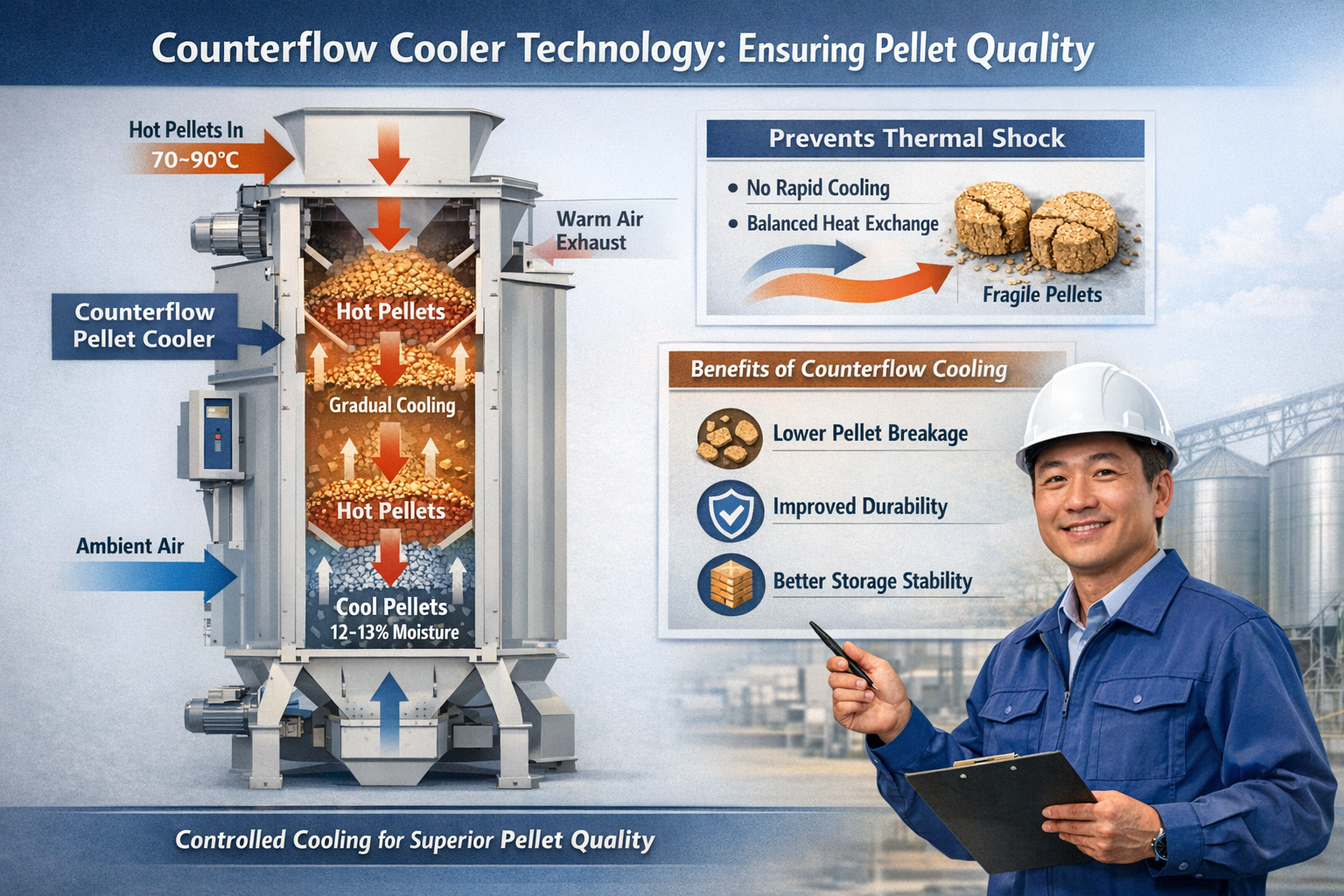
1. The Problem: Why Pellets Break After Production
Freshly produced pellets exiting the pellet mill are:
- High in temperature (typically 70–90°C)
- High in moisture (around 15–18%)
- Structurally soft and mechanically unstable
If these pellets are cooled improperly, several issues arise:
1.1 Thermal Shock and Structural Stress
When hot pellets are exposed to rapid or uneven cooling, the outer layer contracts faster than the inner core. This creates internal stress gradients, leading to:
- Surface cracking
- Internal fractures
- Increased fines during handling and transport
1.2 Moisture Migration and Weak Bonding
Rapid cooling can cause:
- Moisture condensation on pellet surfaces
- Uneven moisture distribution
- Weakening of binding forces within the pellet
1.3 Increased Breakage Rate
Poor cooling directly results in:
- Higher pellet breakage during conveying
- Reduced Pellet Durability Index (PDI)
- Customer complaints and feed loss
Conclusion: Cooling is not just about lowering temperature—it is about controlled stabilization of pellet structure.
2. The Principle: How Counterflow Cooling Works
The counterflow pellet cooler operates based on a simple yet highly effective principle:
Ambient air flows in the opposite direction to the movement of hot pellets.
2.1 Process Flow
- Hot pellets enter the cooler from the top
- Ambient air is drawn from the bottom
- Air moves upward, while pellets move downward
This creates a temperature gradient exchange zone, ensuring gradual and uniform cooling.
2.2 Key Characteristics of Counterflow Cooling
- Progressive cooling: Pellets cool step-by-step rather than abruptly
- Uniform heat exchange: Inner and outer pellet temperatures reduce synchronously
- Moisture equilibrium: Controlled evaporation prevents condensation
2.3 Final Cooling Outcome
Properly cooled pellets achieve:
- Temperature within +3–5°C of ambient
- Moisture reduced to safe storage levels (~12–13%)
- Improved structural integrity
3. The Core Advantage: Preventing Thermal Shock
One of the most critical benefits of counterflow cooling is its ability to eliminate thermal shock.
3.1 What Is Thermal Shock in Pellets?
Thermal shock occurs when:
- External temperature drops rapidly
- Internal temperature remains high
- Resulting stress exceeds material strength
This leads to:
- Microcracks
- Surface peeling
- Structural weakening
3.2 How Counterflow Cooling Solves This
The counterflow system avoids thermal shock through:
(1) Gradual Temperature Reduction
Instead of sudden cooling:
- Bottom pellets (already cooler) meet the coldest air
- Top pellets (hottest) meet warmer exhaust air
This staged cooling prevents abrupt temperature gradients.
(2) Balanced Internal and External Cooling
Heat transfer occurs progressively:
- Core and surface cool at similar rates
- Internal stress is minimized
(3) Controlled Air Velocity
Optimized airflow ensures:
- No excessive drying of outer layers
- No rapid shrinkage of pellet surface
4. Practical Benefits for Feed Manufacturers
Implementing a well-designed counterflow pellet cooler brings measurable operational advantages:
4.1 Reduced Pellet Breakage
- Lower fines generation during handling
- Improved product appearance
- Higher customer satisfaction
- Stronger pellets withstand transportation
- Reduced feed loss in distribution
- Uniform moisture distribution prevents mold growth
- Lower risk of spoilage
- Efficient heat exchange reduces energy consumption
- Optimized airflow lowers fan power requirements
4.2 Improved Pellet Durability (PDI)
4.3 Better Storage Stability
4.4 Energy Efficiency
5. Key Design Considerations for Optimal Performance
Not all cooling systems perform equally. To maximize the benefits of counterflow cooling, attention must be paid to:
5.1 Discharge Mechanism
- Uniform discharge ensures even residence time
- Prevents overcooling or undercooling zones
- Even airflow across the cooling bed is critical
- Avoids dead zones and channeling
- Stable material layer thickness ensures consistent cooling
- Prevents airflow imbalance
- Proper air filtration maintains system efficiency
- Reduces environmental emissions
5.2 Air Distribution System
5.3 Material Level Control
5.4 Dust and Fines Management
6. Common Mistakes to Avoid
Even with a counterflow cooler, poor operation can compromise results:
- Excessive airflow: Causes over-drying and surface cracking
- Insufficient cooling time: Leads to high residual temperature
- Uneven feeding: Results in inconsistent pellet quality
- Ignoring ambient conditions: Seasonal temperature/humidity must be considered
7. Application in Global Feed Production
For international feed manufacturers and exporters, pellet quality is directly linked to market competitiveness. During long-distance transport:
- Pellets are exposed to vibration and mechanical stress
- Temperature fluctuations can worsen structural weaknesses
A properly configured counterflow pellet cooler ensures that pellets arrive at destination markets with:
- Minimal breakage
- Consistent quality
- Compliance with international standards
8. Conclusion: Cooling Defines Final Pellet Quality
While pelleting forms the product, cooling defines its final quality.
The counterflow pellet cooler stands out as the most effective solution because it:
- Follows a scientifically optimized feed pellet cooling principle
- Prevents thermal shock and internal stress
- Significantly reduces pellet breakage
- Enhances durability, storage stability, and overall product value
For feed manufacturers aiming to improve product consistency and reduce post-production losses, investing in advanced counterflow cooling technology is not optional—it is essential.
About Us
With extensive experience in feed engineering and equipment manufacturing, we provide customized counterflow cooling solutions designed for different production capacities and raw material conditions. Our systems focus on:
- Precision airflow control
- Stable discharge mechanisms
- Energy-efficient operation
- Long-term reliability
If you are looking to optimize pellet quality and reduce breakage in your production line, our engineering team is ready to support you with practical, results-driven solutions.